Overview
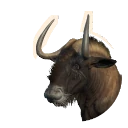
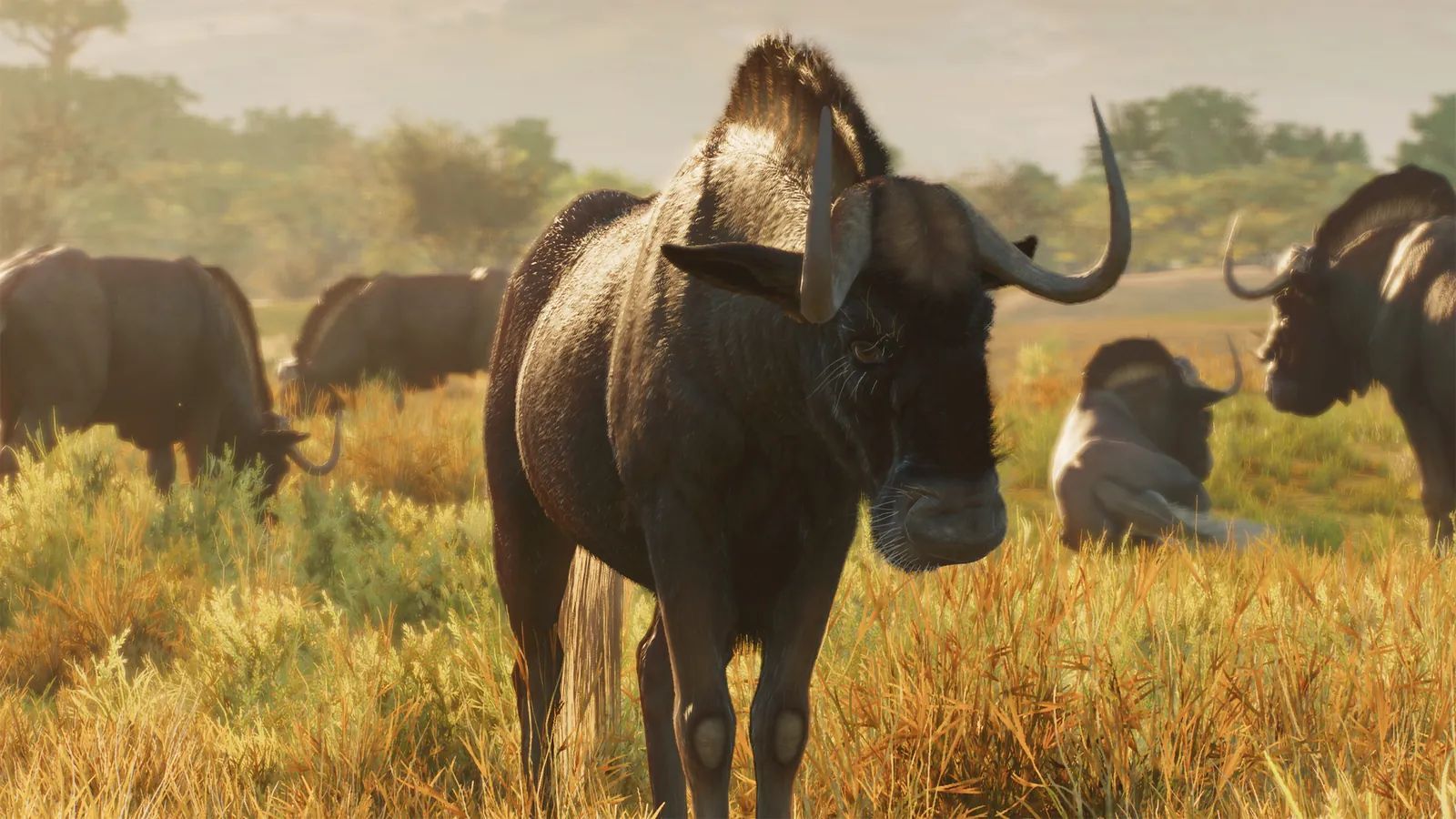
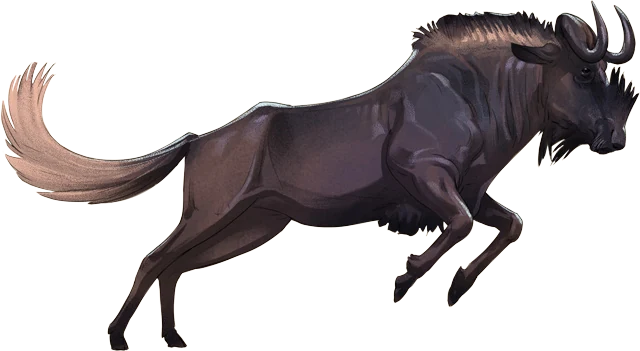
The black wildebeest (or Connochaetes gnou) is a large ungulate species native to Southern Africa, also known as the white-tailed gnu after the distinctive noise they make when alarmed. The species is recognisable by a brown-black coat and L-shaped horns, and distinctive white tail. Both sexes have thick, bushy manes. Males tend to be slightly darker and larger than females, standing 1.11m to 1.21m tall at the shoulder and weighing 147kg to 193kg. Females stand 1.06m to 1.16m tall and weigh 120kg to 160kg.
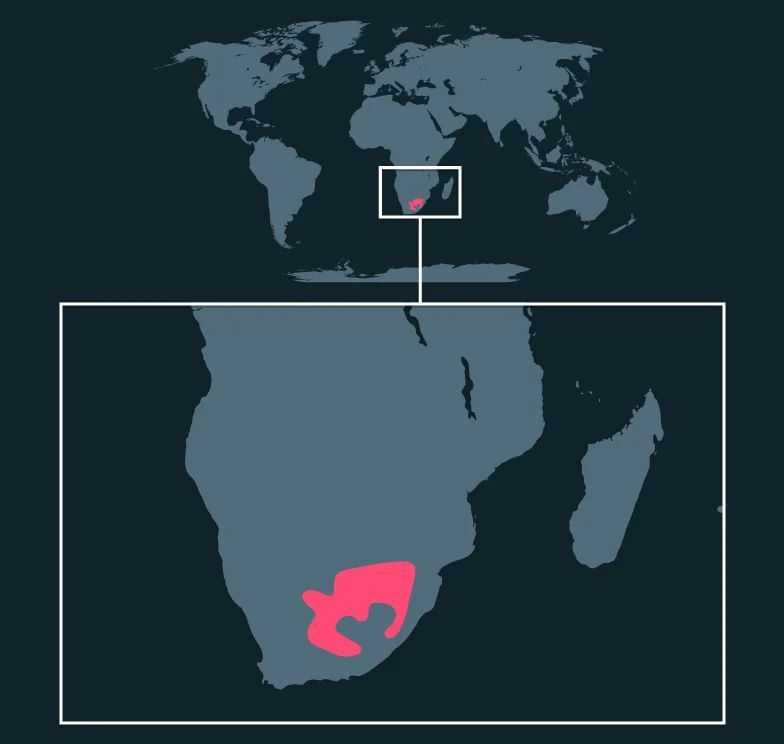
Found in Southern Africa
Regions
- Africa
Biomes
- Savannah
Size & weight
Size
Shoulder height: 1.05 to 1.1 m
Weight
Male
170 kg
Female
140 kg
Bars use a log scale against the heaviest animal in the Zoopedia, the Common Hippopotamus.
Measured as Shoulder height. The person stands 1.75 m tall for scale.
Habitat requirements
Barrier grade
Grade 2 of 5
Minimum height
1.25 m minimum
Climbing & water
Climb proof
Not needed
Water barrier
Not allowed
Combine this animal with others in the barrier planner.
Conservation
IUCN Red List
Least concern
Least concern
Critically endangered
Wild population
11,160
11,160 in the wild. Rank 21 of 57 species with a known count, smallest first.
Today a species of Least Concern, the black wildebeest has a dark past. Once widespread across the grasslands of Southern Africa, it was almost driven to extinction in the 19th and 20th centuries due to uncontrolled hunting. Open grassland conversion into farmland restricted migration paths, and the remaining fragmented and isolated populations were highly vulnerable to genetic bottlenecks, disease and predation. While the population has stabilised somewhat, they are still threatened by poaching and vehicle collision today. Black wildebeest are fully protected in several Southern African countries, and populations are reintroduced to National Parks, private reserves and conservancies. Using wildlife corridors and large unfenced areas, populations are connected to maintain genetic diversity. Additionally, captive breeding programs in reserves and zoos reinforce populations and safeguard against extinction. Together, legal protection and conservation measures have helped black wildebeest recover from near-extinction, turning them into a conservation success story, though ongoing management is essential to sustain their long-term survival.
Zoopedia sketchbook
Social & reproduction
Keeper notes
Black wildebeest live in large herds comprised of groups of related females and their young offspring; bachelor herds of young males; and dominant bulls who establish territory in the foraging grounds, guarding females moving through his range. During the breeding season from February to April, dominant bulls gather harems of receptive females on their territories. The male determines if a female is in oestrus by sampling her urine and mates with her, if receptive. Males will defend their harems from rivals, and spend little time grazing during this time, leaving them weakened at the end of the season. A pregnancy lasts for 8.5 months before the female gives birth to a single calf. Unlike other herding species, black wildebeest calves are born directly in the herd and are not hidden away. The calf remains close to its mother for about a year and nursed for 6 to 8 months, though it will begin eating solid food as early as 1 month old. When the mother gives birth to her next calf a year later, the young become independent from her. Females remain with their natal herd, and males join bachelor herds. Sexual maturity is reached at about 3 years old.
Animal facts
- The horns of the black wildebeest are significantly larger and heavier than those of the blue wildebeest.
- Both male and female wildebeest have horns, but the males' horns are longer and thicker than the females'.
- During the mating season, dominant male wildebeests do not eat or sleep as they are so intent on mating and defending their mates from rival males.
- Black wildebeest can run up to 80km/h when running from predators such as lions and hyenas.
- Female groups of black wildebeest are strongly bonded and will be hostile to unknown females trying to join their group.
Taxonomy
Class
Order
Family
Genus
Species