Overview
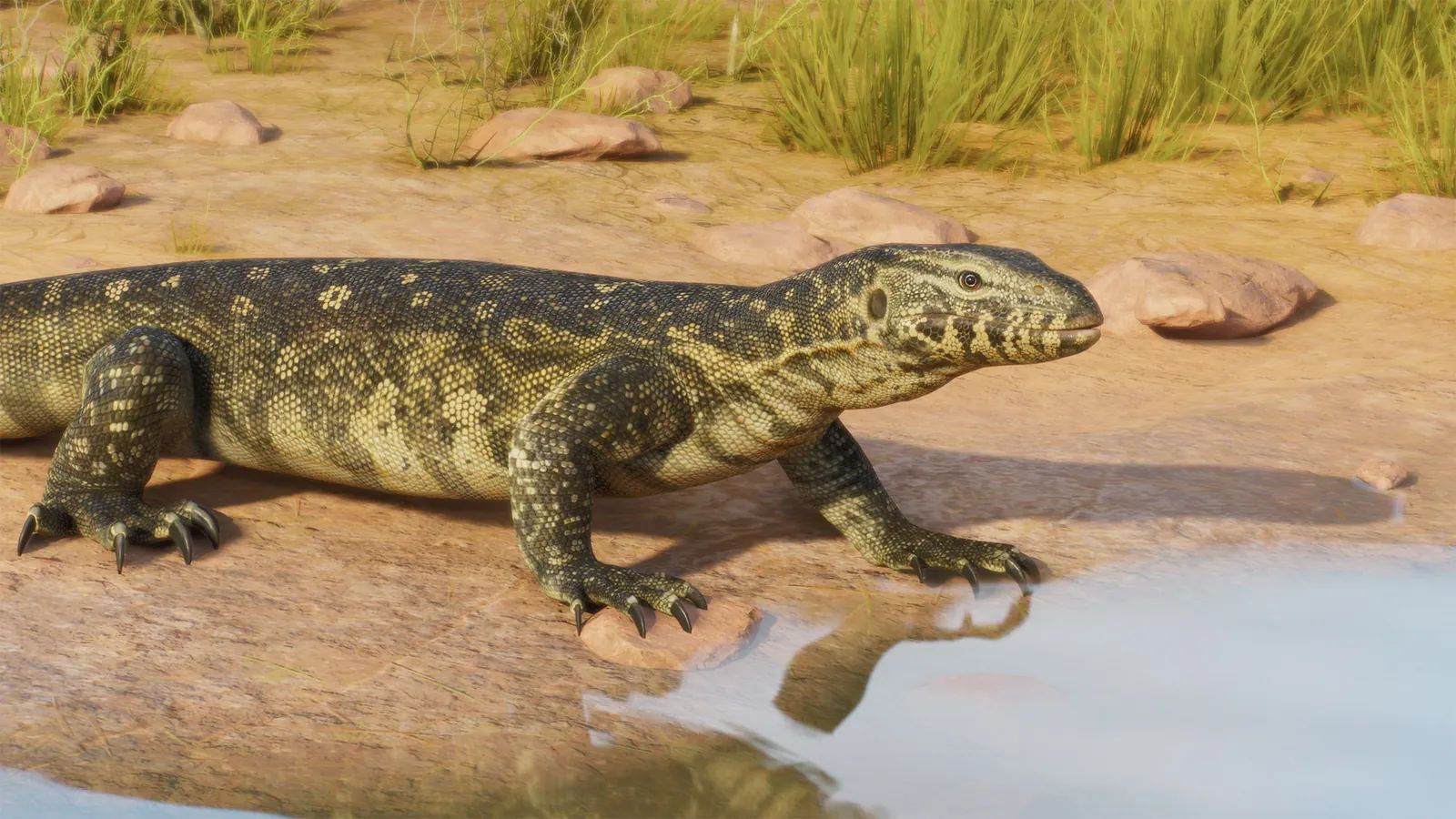
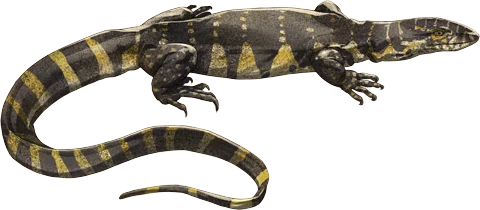
The Nile monitor (or Varanus niloticus) is a large species of reptile that lives in the non-desert area of Sub-Saharan Africa, and prefer environments close to water. They have also been introduced to the USA – specifically California and Florida – where they are regarded as an invasive species. It is also known as the African small-grain lizard, guana, water leguaan or river leguaan. Adult nile monitors tend to be brown to green, with dark stripes on their body and yellow spots on their legs and head. Meanwhile, juveniles are black with bright yellow spots. They grow between 1.2m and 2.2m long, growing throughout their lives. Weight ranges from 0.8kg to 15kg, with great variation across size and environmental factors. Males tend to be larger and heavier than females.
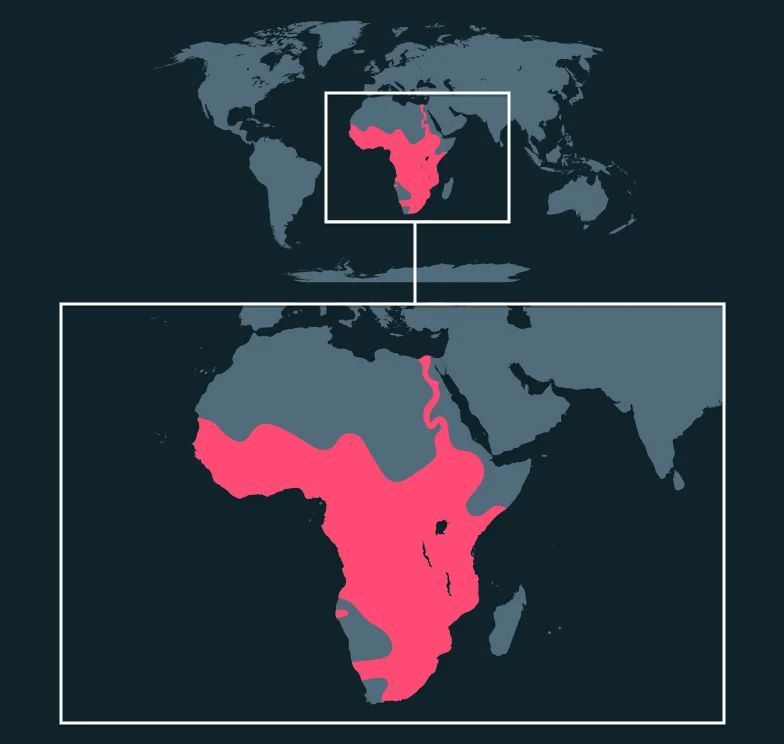
Found in Sub-Saharan Africa and Nile Delta
Regions
- Africa
Biomes
- Grassland
- Wetlands
Size & weight
Size
Length: 1.9 to 2.1 m
Weight
Male
8 kg
Female
8 kg
Bars use a log scale against the heaviest animal in the Zoopedia, the Common Hippopotamus.
Measured as Length. The person stands 1.75 m tall for scale.
Habitat requirements
Barrier grade
Grade 2 of 5
Minimum height
0.5 m minimum
Climbing & water
Climb proof
Not needed
Water barrier
Not allowed
Combine this animal with others in the barrier planner.
Habitat needs
Minimum area
Land
220 m² + 40 m² per extra animal
Water
30 m² + 15 m² per extra animal
Environment
Temperature
20-41°C
Plant coverage
0-30%
Enclosure
Habitat
Terrain
- Grass 0-50%
- Sand 0-40%
- Soil 30-80%
- Rock 0-40%
- Waterlogged 20-70%
Diet and enrichment
Diet
- Rodents
- Meat Cuts
Feeders
- Bamboo Feeder
- Block of Frozen Fish
- Food Tray - Large
- Food Tray - Small
- Frozen Blood Pumpkin
- Restraint Feeder
Enrichment items
- Blood Scent Marker
- Mud Bath
- Platform Floats
- Prey-scented Sack
- Rubbing Pad
- Rubbing Pad Bark
- Small Ball
- Submarine Buoy
Conservation
IUCN Red List
Least concern
Least concern
Critically endangered
Due to its wide distribution across sub-Saharan Africa and adaptability to a range of habitats, the Nile monitor is considered a species of Least Concern. However, local populations face increasing conservation struggles from habitat conversion and overharvesting for their skins. Wetland drainage and human expansion destroy critical nesting and foraging areas. Their reliance on specific microhabitats for burrowing and nesting make them susceptible to long-term decline if habitat degradation continues. The Nile monitor is not a focus of conservation efforts in most regions, though some countries include them in wildlife protection laws, and international trade is restricted under CITES Appendix II; but legislation is not often enforced, and data collection is minimal. They benefit, however, from general habitat restoration initiatives that include them as part of the natural biodiversity. In regions where Nile monitors are invasive, i.e. Florida, management includes trapping and public reporting systems to control populations and protect native species.
Zoopedia sketchbook
Social & reproduction
Keeper notes
Nile monitors are solitary animals and prefer to be alone. Nile monitors mate from June to October. After tracking a female by scent, a male will follow her until one of two scenarios: either she allows him to mate with her, or he gives up. If two or more males meet when tracking females then they will fight, or the smaller monitor will yield to the larger one immediately. Having mated, a female will carry her eggs with her until the rainy season. After a rainfall, she will dig a nest in the soft ground before covering her eggs over, and these will incubate for 3 to 10 months depending on the environmental conditions. The newly hatched young must dig their way out of the nest and may need to wait for it to rain to be able to get out, although some mothers do return to their nests to help. After hatchlings emerge, they live independently and reach sexual maturity at 3 to 4 years old.
Group and breeding
Group
Group size
1-3 (up to 1 male, up to 2 females)
Male bachelor group
1-3
Female bachelor group
1-3
Offspring dispersal
None
Mating system
Promiscuous
Mating season
Summer
Reproduction in captivity
Average
Lifecycle
Life expectancy
10-20 years
Sexual maturity
4 years
Sexual sterility
Death
Gestation or incubation
1 month
Interbirth period
11 months
Litter size
2-8
Animal facts
- Many female Nile monitors break into termite nests and lay their eggs inside them because the termites repair the damage afterwards and thus shelter the eggs.
- When in danger or antagonised, the Nile monitor will attack with a powerful whip from its long tail.
- Nile monitors are preyed upon by martial eagles, which can pick up and carry a lizard weighing up to 4kg.
- Nile monitors are causing the crocodile and alligator population in Florida to decrease because they are so effective at robbing their nests of eggs and hatchlings.
- Nile monitors never stop growing; they continue to get larger throughout their lives.
Taxonomy
Class
Order
Family
Genus
Species