Overview
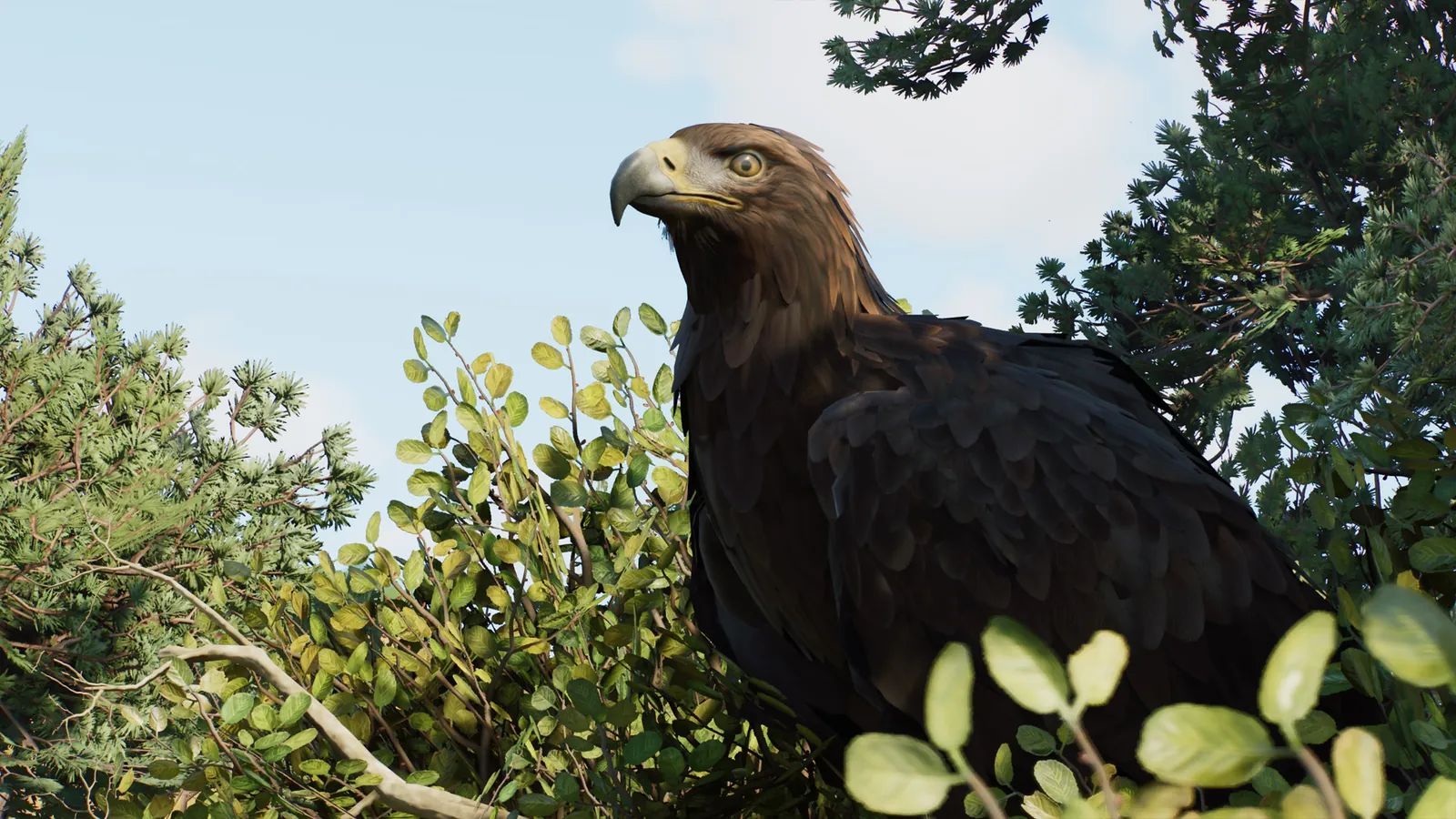
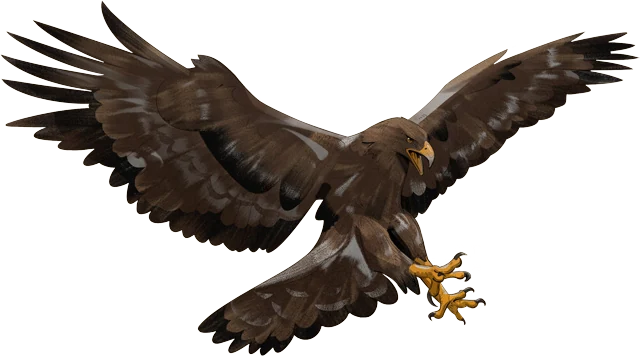
The golden eagle (or Aquila chrysaetos) is one of the most widespread birds of prey, ranging across the Northern Hemisphere in North America, Europe, Asia, and parts of North Africa. It favours open or semi-open habitats such as mountains, grasslands, tundra, and deserts, often nesting on cliffs or tall trees that provide wide views of its hunting grounds. Golden eagles have dark brown plumage accented by golden feathers on the nape and crown, powerful talons, and a sharp, hooked beak. They have a wingspan between 1.8m and 2.3m and a body length of 70cm to 100cm. Like in most raptors, females are slightly larger and heavier than males. Adult males generally weigh between 3kg and 5kg, while females weigh 4kg to 6.5kg.

Found in North America, Europe, Northern Africa, Asia
Regions
- Africa
- Asia
- Europe
- North America
Biomes
- Desert
- Savannah
- Taiga
- Temperate
- Tundra
Size & weight
Size
Leg span: 1.97 to 2.14 m
Measured as Leg span. The person stands 1.75 m tall for scale.
Habitat requirements
Barrier grade
Grade 2 of 5
Minimum height
1 m minimum
Climbing & water
Climb proof
Not needed
Water barrier
Not allowed
Combine this animal with others in the barrier planner.
Conservation
IUCN Red List
Least concern
Least concern
Critically endangered
Wild population
85,000
85,000 - 160,000 in the wild. Rank 37 of 57 species with a known count, smallest first.
While considered to be of Least Concern, the golden eagle is threatened by habitat loss and fragmentation due to land conversion for agricultural, forestry, urban and infrastructure use. This limits their ability to hunt, find mates, and nest. In some areas, they are also directly persecuted by shooting, trapping and poisoning. Secondary lead poisoning from eating carcasses containing ammunition is also a threat. They are also at risk from collision and electrocution by power lines or wind turbines. Climate change additionally alters prey and habitat availability. Many efforts go into recovery help and better habitat protection. In the UK, juvenile and sub-adult golden eagles have been translocated to improve the population in Southern Scotland, with considerable success. Legal protection is also strong in many countries, making it illegal to harm or disturb the birds and their nests. Moreover, habitat restoration and land management practices are improved in many places to reduce human‐caused mortality and enhance habitat connectivity.
Zoopedia sketchbook
Social & reproduction
Keeper notes
Golden eagles are generally solitary or live in pairs, and most of their interactions are limited to mating and raising young. Adults strongly defend large territories against other golden eagles, especially during the breeding season. Golden eagles form long-term, often lifelong, monogamous pair bonds. Courtship usually takes place in late winter to early spring and includes synchronised soaring, circling, and aerial dives. Both new and existing pairs perform these displays to create or reaffirm their bond. Together, a pair builds or refurbishes their nest, or eyrie, on a cliff, tall tree or other tall vantage points. After mating, the female typically lays 1 to 4 eggs, though two is most common, and she incubates them for about 40 to 45 days while the male provides food. Hatchlings are covered in white down and grow quickly, though competition between siblings can be intense, often leading to the survival of only 1 or 2 chicks. The young fledge at around 10 to 12 weeks of age, but may remain dependent on the parents for food and protection for several more months, before finally dispersing. Golden eagles reach maturity at about 4 to 5 years old, at which point they establish their own territories and search for a mate of their own.
Animal facts
- Golden eagles can reach speeds up to 193km/h when diving, or ‘stooping’, after prey.
- Golden eagle nests are large structures: average nests are about 1.7m to 2m wide and 60cm high, but some record nests have been 6m tall and 2.6m wide.
- Golden eagles use and reuse and add to the same nests or territories over many years.
- Young golden eagles usually have white patches which they lose with moults as they approach adult plumage.
- A golden eagle’s vision is 4 to 8 times stronger than a human’s, allowing it to spot prey from over 3 kilometres away.
Taxonomy
Class
Order
Family
Genus
Species