Overview
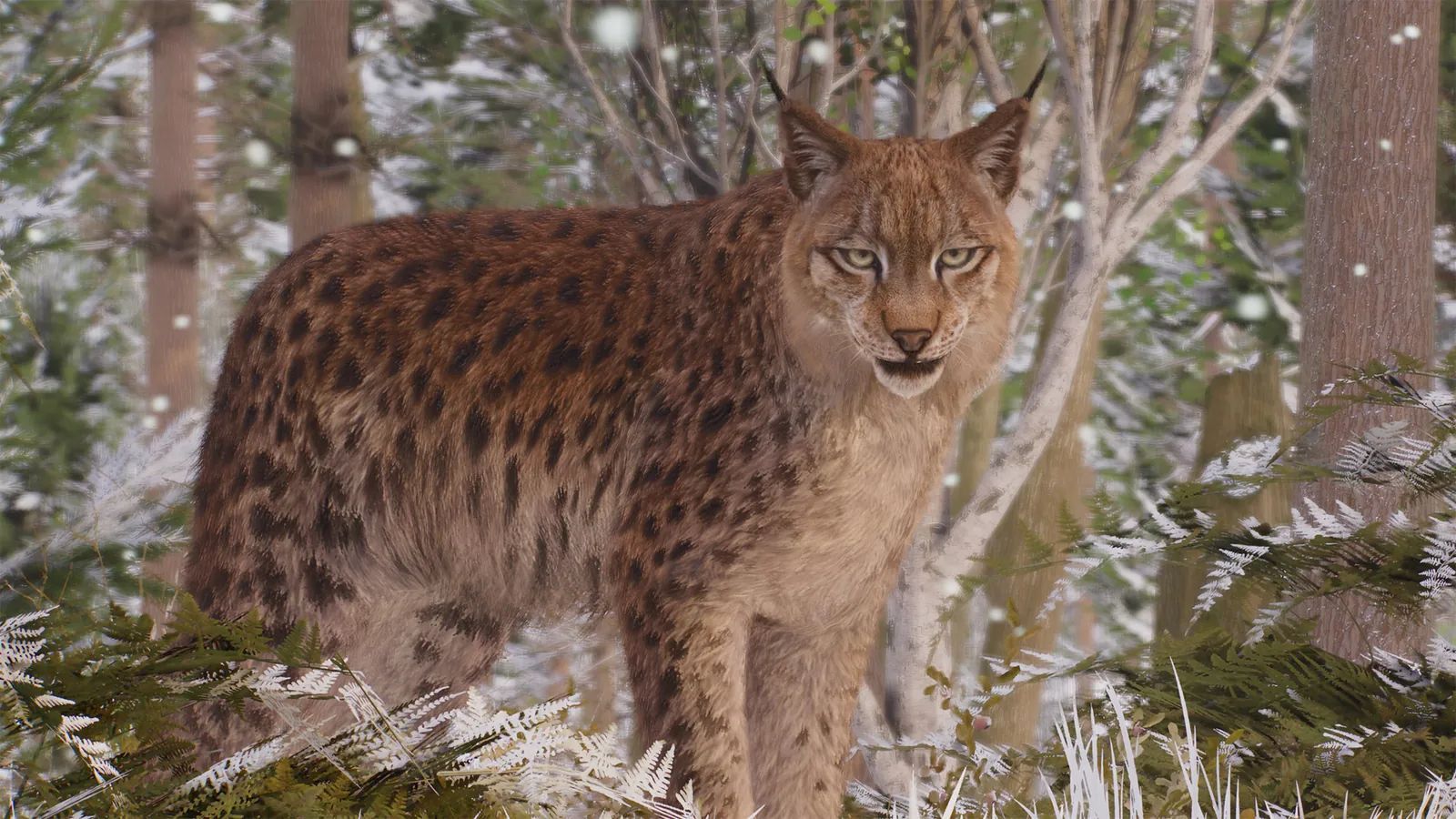
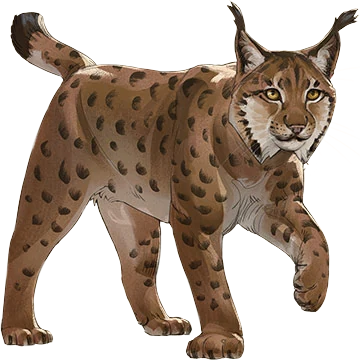
The Eurasian lynx (or Lynx lynx) is a medium-sized cat that is found in temperate and boreal forest and mountains of Europe and Asia. It has a broad, stocky build with large feet, and is known for its short tail and distinctive ear tufts. Its coat colour ranges from cream to tan, with black spots all over the body. Both the tail tip and ear tufts are black too. Males and females look alike, although males are slightly larger and significantly heavier. Male Eurasian lynxes weigh 20kg up to 45kg, with a head-body length of 98cm to 109cm and shoulder height of 60cm to 75cm. Female lynxes only weigh 18kg to 25kg, measure 94cm to 106cm in head-body length and stand 54cm to 68cm tall at the shoulder. The stubby tail is 11cm to 24cm long in both sexes.
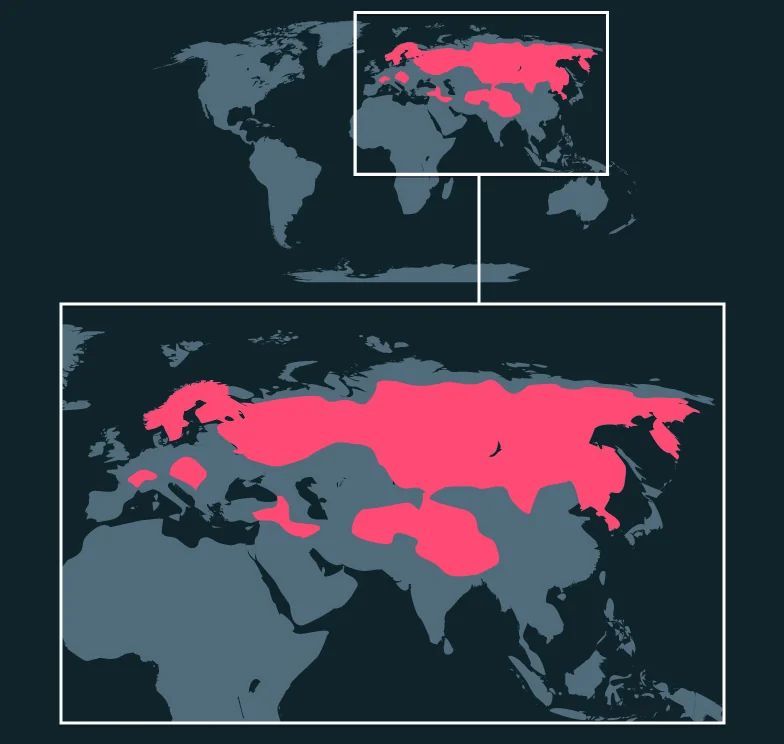
Found in Europe and Asia
Regions
- Asia
- Europe
Biomes
- Taiga
- Temperate
- Tundra
Size & weight
Size
Shoulder height: 0.58 to 0.63 m
Measured as Shoulder height. The person stands 1.75 m tall for scale.
Habitat requirements
Barrier grade
Grade 2 of 5
Minimum height
3 m minimum
Climbing & water
Climb proof
Needed
Water barrier
Not allowed
Combine this animal with others in the barrier planner.
Conservation
IUCN Red List
Least concern
Least concern
Critically endangered
Wild population
50,000
50,000 in the wild. Rank 34 of 57 species with a known count, smallest first.
Facing significant conservation struggles over the past two centuries, the Eurasian lynx is today a species of Least Concern. Lynx populations had been eradicated from much of Western and Central Europe by the mid-20th century due to retaliatory killing and fur hunting, prey depletion of key species like roe deer, and habitat loss due to deforestation. Lynx only survived in isolated pockets in Eastern and Northern Europe and Asia. A range of mitigation strategies enabled the comeback of this elusive predator. Legal protection and habitat restoration have paved the way for reintroduction programs. These re-established breeding populations in countries like Germany, Switzerland and Slovenia and successfully resulted in wild-born cubs. These efforts are supported by public education campaigns, GPS monitoring, and cross-border cooperation to ensure genetic diversity and long-term viability. As a keystone species, lynx play a vital role in maintaining healthy ecosystems through prey population control, making their recovery a symbol of broader ecological restoration.
Zoopedia sketchbook
Social & reproduction
Keeper notes
In the wild, lynx are solitary animals and live alone except for mothers with their cubs. However, male and female lynx are known to form strong bonds in captivity. The mating season of the Eurasian lynx is in late winter, when lynx will call and scent mark far more than at any other time of the year. If a male locates a female, he will follow her for 3 to 5 days. During this period, they will sniff and rub against each other, play, hunt, and sleep together. The female is fertile for 1 to 10 days, once she is no longer receptive the male will leave and attempt to find another female. If two males locate the same female, they may fight over her. Pregnancies last between 67 and 74 days, after which the female will give birth to a litter of 1 to 4 cubs. In preparation of the birth she will set up a den in a cave, hollow log, or dense roots and undergrowth. After birth cubs are helpless and entirely depend on their mother for food and warmth. They will begin to walk, eat solid food and explore outside their den after 3 to 4 weeks. Cubs are weaned between 3 and 5 months of age but will remain with their mother until she is fertile again, which can take between 1 to 3 years – as long as they have cubs with them, females will not get pregnant. After leaving their mother, lynx cubs remain together for several months. Female Eurasian lynxes reach sexual maturity between 21 and 27 months old, males around a year later at 30 to 36 months old.
Animal facts
- The Eurasian lynx is the largest of the four species of lynx, and has one of the widest ranges of all wild cats.
- During the winter, the Eurasian lynx grows thick fur on its feet so it can move unimpeded through the snow.
- The Eurasian lynx is an extremely quiet animal except during the mating season, when they vocalise a lot in order to locate and attract mates.
- The Eurasian lynx is Romania’s National animal.
- Due to the wide distribution of the Eurasian lynx, there are multiple described subspecies, although definitive subspecies placement can often prove difficult due to overlapping ranges and similar appearances.
Taxonomy
Class
Order
Family
Genus
Species