Overview
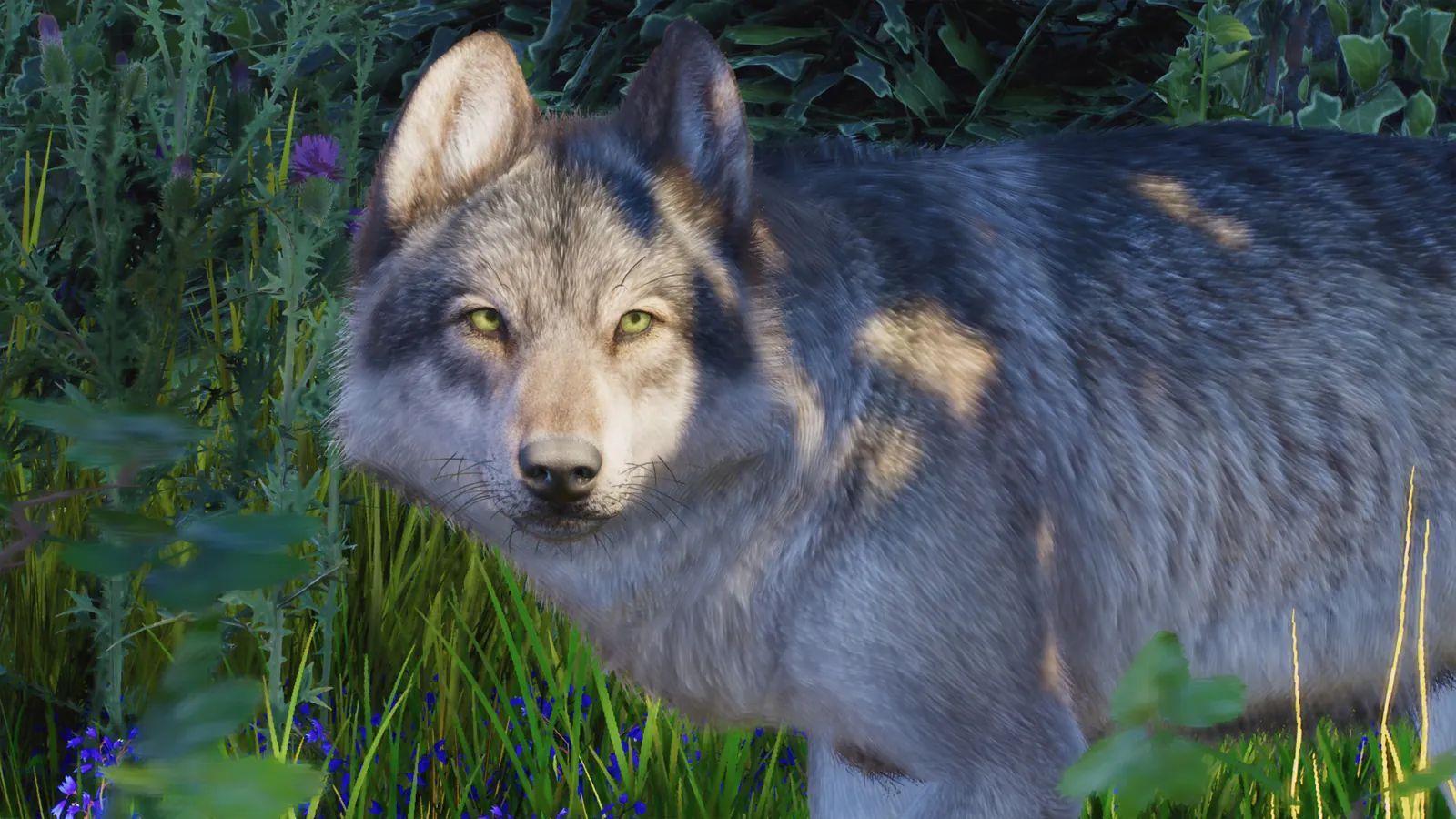
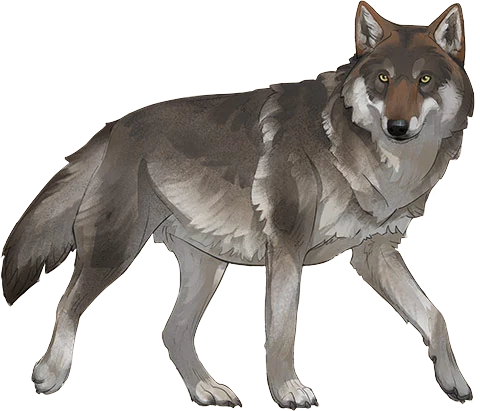
Grey wolves (or Canis lupus) are a large canid species that live across most of the Northern hemisphere. They are large generalist predators who will eat most prey they are able to catch and are able to live in a huge variety of environments. The appearance of grey wolves has a lot of variety depending on which population is being observed - there are 38 subspecies of the grey wolf with adaptations to their specific environments. In general, grey wolves have a mottled grey-brown fur coat, pointed ears and a long straight snout. They have a slim build with a deep rib cage and long legs. Wolves measure 105cm to 160cm long with a 29cm to 50cm long tail and stand 80cm to 85cm tall at the shoulder. Males weigh between 43kg and 45kg and females weigh between 36kg and 38.5kg.

Found in Europe, Asia, North America
Regions
- Asia
- Europe
- North America
Biomes
- Desert
- Rainforest
- Savannah
- Taiga
- Temperate
- Tundra
Size & weight
Size
Shoulder height: 0.8 m
Weight
Male
44 kg
Female
37 kg
Bars use a log scale against the heaviest animal in the Zoopedia, the Common Hippopotamus.
Measured as Shoulder height. The person stands 1.75 m tall for scale.
Habitat requirements
Barrier grade
Grade 3 of 5
Minimum height
3 m minimum
Climbing & water
Climb proof
Not needed
Water barrier
Not allowed
Combine this animal with others in the barrier planner.
Conservation
IUCN Red List
Least concern
Least concern
Critically endangered
Wild population
200,000
200,000 - 250,000 in the wild. Rank 44 of 57 species with a known count, smallest first.
While currently assessed as Least Concern, the grey wolf has faced significant challenges through centuries of persecution and habitat loss. Historically hunted to near extinction across much of Europe and North America, wolves were (and partly still are) viewed as threats to livestock and human safety. Fragmented habitats, vehicle collisions, and illegal killings further threaten wolf populations. Thanks to improved legal protection, grey wolf populations have rebounded over recent decades. In the US, the reintroduction of wolves to Yellowstone National Park in 1995 helped restore ecological balance and biodiversity. In Europe, wolves have returned naturally to many areas, thanks to legal protection under the EU Habitats Directive. Populations have expanded in many Eastern and Central European countries and recolonised former habitats. Initiatives such as compensation for livestock losses, monitoring programs, and public awareness campaigns have been crucial in supporting their recovery across Europe, showing that wolf populations can be re-established even in human-dominated landscapes with the right conservation measures.
Zoopedia sketchbook
Social & reproduction
Keeper notes
Wolves are very social animals that live in family packs. An average pack contains one alpha male, one alpha female, their young adult offspring, and a litter of pups that are less than a year old. Wolf packs are closely bonded, and wolves get distressed if their pack is separated or if a pack member dies. In a wolf pack, the alpha male and alpha female are monogamously bonded and mate for life, and only they have young within the pack. As the female approaches oestrus, the pair strengthen their bond through close physical contact and grooming. After a pregnancy lasting about 2.5 months, the female gives birth to a litter of 5 to 7 pups in a secluded den, where she remains for the first three weeks to care for the newborns. During this period, she is fed by the alpha male, and no other pack members are allowed inside the den. At around 3 or 4 weeks, the pups begin eating solid food regurgitated by adults, and by 8 weeks, they are fully weaned. The pups start to accompany the pack on hunts, typically by 4 to 6 months, where they begin learning essential survival skills. Grey wolves reach sexual maturity around 2 to 3 years old. Pups usually remain with their natal pack until 10 months to 4 years old, with the timing influenced by food availability and sexual maturity. Lone wolves look to meet another lone wolf of the opposite sex and establish a territory. If they find a partner, they mate during the breeding season and reproduce a litter of pups once a year and will stay together for life.
Animal facts
- Wolves, with the exception of some breeds of domestic dog, are the largest canid species.
- Wolves howl as an alarm call, to assemble the pack, to locate each other if they get separated, or to communicate across long distances.
- In North America, wolves have hybridised with domestic dogs, which has introduced black colouration into the wolf population.
- Wolves in cold countries can withstand temperatures of -40°C. When it is this cold, wolves lie close to the ground and use their tail as a muffler over their face.
- Wolves are apex predators, they are only threatened by humans, bears and tigers.
Taxonomy
Class
Order
Family
Genus
Species