Overview
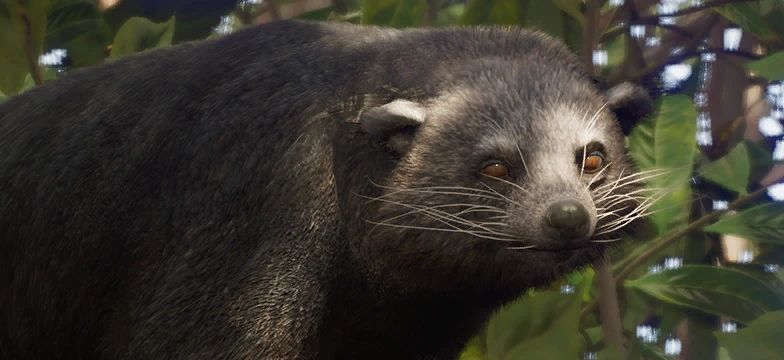
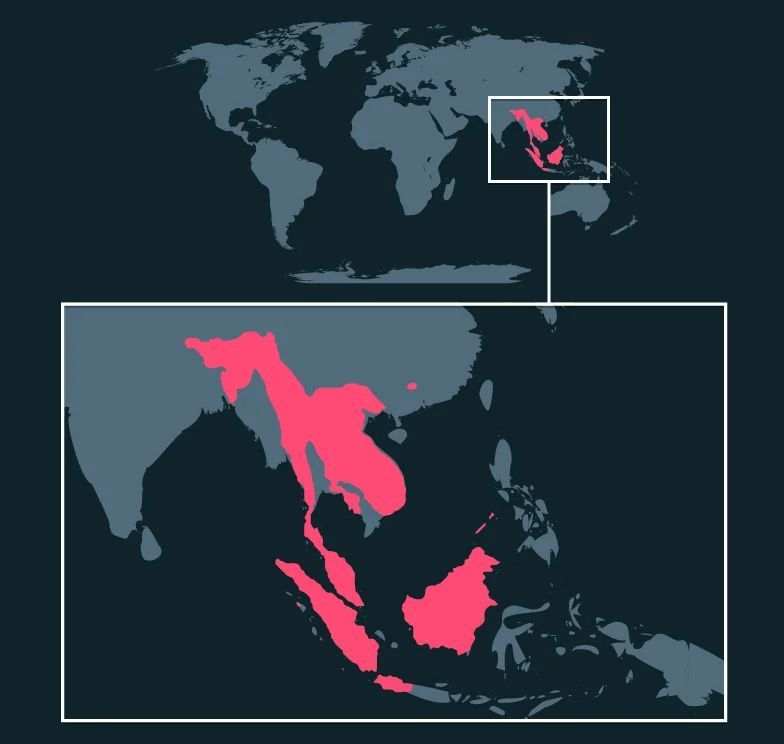
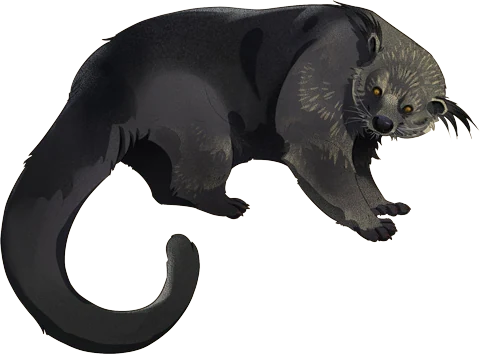
The binturong (or Arctictis binturong), also known as the bearcat, is a species of mammal that lives in the forests of South and Southeast Asia. It has a long, stocky body with comparatively short, broad legs. They have wiry black hair with a brown face and white-tipped rounded ears. Females are approximately 20% larger than the males. The binturong has a head-body length of 71cm to 91cm, and a tail length of 56cm to 91cm. The males weigh between 9kg and 20kg and the females weigh between 11kg and 32kg.
Found in Asia
Regions
- Asia
Biomes
- Tropical
Size & weight
Size
Nose to rump: 0.71 to 0.84 m
Measured as Nose to rump. The person stands 1.75 m tall for scale.
Habitat requirements
Barrier grade
Grade 2 of 5
Minimum height
3 m minimum
Climbing & water
Climb proof
Needed
Water barrier
Not allowed
Combine this animal with others in the barrier planner.
Habitat needs
Minimum area
Land
182 m² + 18 m² per extra animal
Climbing
60 m² + 16 m² per extra animal
Shelter
4 m² per animal
Environment
Temperature
18 to 33°C
Plant coverage
25-100%
Enclosure
Climb-Proof Habitat
Terrain
- Grass 0-100%
- Sand 0-20%
- Soil 0-100%
- Rock 0-20%
Diet and enrichment
Diet
- Nutritionally Complete Meat
- Fruit






Enrichment items




Conservation
IUCN Red List
Vulnerable
Least concern
Critically endangered
Binturongs are considered a Vulnerable species. The binturong is threatened by habitat loss, degradation and fragmentation through deforestation, as the species is highly dependent on intact forest canopies for foraging and movement. Its population has declined by 30% since the 1980s. It is also hunted for meat in Laos and Vietnam, and is often a victim of the wildlife trade in the Philippines. Protected area networks and reforestation initiatives across South East Asia aim to restore and connect fragmented forests, providing safer corridors for wildlife movement. Organisations and various zoos collaborate to raise awareness, conduct field research, and promote community education on the species’ ecological importance, particularly its role in seed dispersal for strangler fig trees. Captive breeding programs also contribute to maintaining genetic diversity and may support future reintroduction efforts. While challenges remain, these combined conservation measures offer hope for stabilising and eventually increasing binturong populations in the wild.
Zoopedia sketchbook
Social & reproduction
Keeper notes
The binturong is a solitary animal but is not territorial and individuals will tolerate each other in the same space. If two binturongs meet, they are likely to avoid each other unless it is a male and female and the female is in oestrus. They may also be found in groups of a female and her litter or a mated pair and their litter. Larger same sex groups have been kept together successfully in captivity. Binturongs mate throughout the year, but females are more likely to give birth between January and March. The reproductive habits of binturongs in the wild are little known, but they are thought to be monogamous. When the female is in oestrus, she will make calls and emit a scent that attracts males. In response, males in range will mark excessively with urine and track the female. During courtship, a male and female will become very affectionate with each other. They will lick each other, touch each other and sleep with their tails entwined. The male may be aggressive towards other approaching males. During copulation, the male and female will purr at each other. Binturongs are able to delay egg implantation until conditions are favourable, which explains why there are peaks in birthing at certain times of year. Young are born in an underdeveloped state and spend their first few days hidden in their mother’s fur. They begin eating solid food at 6 weeks old and are fully weaned by 8 weeks old. Males may or may not assist in rearing young. Kits or cubs (the young can be referred to as both) are independent and leave their parents and litter at 6 to 8 months old. Binturong males reach sexual maturity at 28 months old and females at 30 months old.
Group and breeding
Group
Group size
1-5 (up to 5 males, up to 5 females)
Male bachelor group
1-5
Female bachelor group
1-5
Offspring dispersal
All offspring
Lifecycle and breeding
Life expectancy
15-25 years
Age of sexual maturity
2.5 years
Age of sexual sterility
15 years
Gestation or incubation
3 months
Interbirth period
9 months
Litter size
1-3
Mating system
Monogamous
Mating season
Aseasonal
Reproduction in captivity
Difficult
Animal facts
- The genus of the binturong is ‘Arctictis’ which means ‘bear-weasel’.
- The binturong is an excellent climber but is slow moving so does not leap from branch to branch, instead preferring to move between trees on the ground.
- Binturongs are a very vocal species, making ‘purring’ and ‘chuckling’ noises when happy and ‘wailing’ when upset.
- The binturong is an important seed disperser for the strangler fig because unlike other animals, its digestive system can break through the tough seed shell.
- The binturong’s scent glands secrete a substance that smells like popcorn.
Taxonomy
Class
Order
Family
Genus
Species