Overview
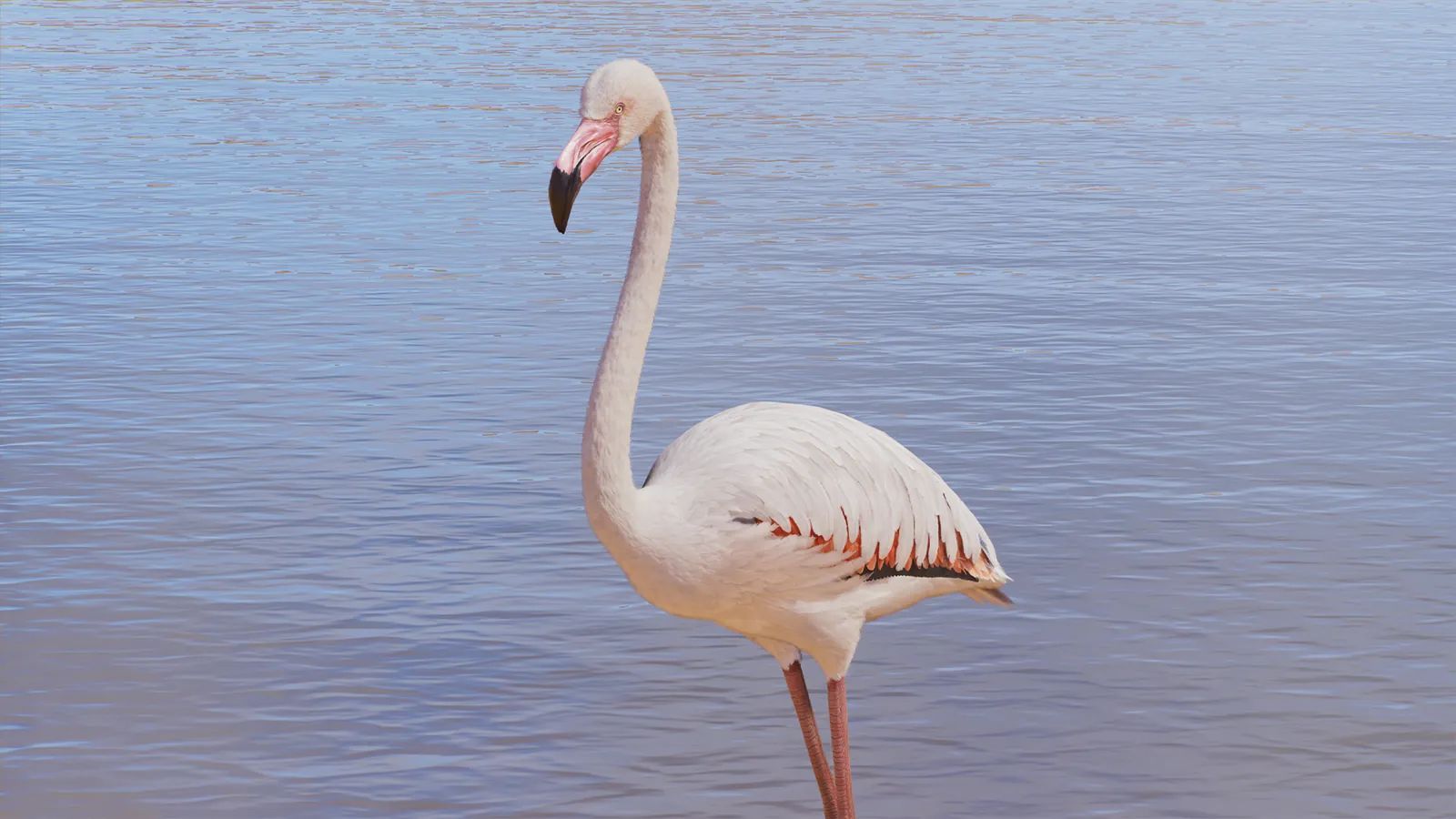
The greater flamingo (or Phoenicopterus roseus) is a large species of migratory bird that is widespread across Europe, the Middle East, Asia and Africa. It lives on the mudflats and coastal lagoons of temperate and warm environments, and is a filter feeder which uses its beak to stir up mud and filter out algae, invertebrates and seeds. They are covered with pale-pink to orange-pink feathers, pink legs and a pink beak with a black tip. They have black flight feathers and often brighter pink patches on their wings. Male and female flamingoes look the same, measuring between 1.1m and 1.5m tall, and weighing between 2kg and 4kg.

Found in Africa, Asia, Europe
Regions
- Africa
- Asia
- Europe
Biomes
- Estuarine
- Temperate
- Wetlands
Size & weight
Size
Height: 1.35 to 1.6 m
Weight
Male
3 kg
Female
3 kg
Bars use a log scale against the heaviest animal in the Zoopedia, the Common Hippopotamus.
Measured as Height. The person stands 1.75 m tall for scale.
Habitat requirements
Barrier grade
Grade 1 of 5
Minimum height
1 m minimum
Climbing & water
Climb proof
Not needed
Water barrier
Not allowed
Combine this animal with others in the barrier planner.
Conservation
IUCN Red List
Least concern
Least concern
Critically endangered
Wild population
550,000
550,000 - 910,000 in the wild. Rank 52 of 58 species with a known count, smallest first.
The greater flamingo is of Least Concern and not endangered, but is still affected by the increasing degradation of the saline and alkaline wetlands that they depend on. Wetland drainage, water diversion or pollution for agriculture or infrastructure kills many of the invertebrates on which flamingoes feed and damages suitable breeding habitat. Local disturbances from human recreational activities or livestock may also lead to colony abandonment. Habitat protection and management initiatives such as water quality monitoring, protection of important breeding and stopover sites, and public awareness campaigns are confronting these threats. International frameworks such as the African-Eurasian Migratory Waterbirds Agreement (AEWA) aid coordination of international conservation efforts, while national governments have protected key sites to safeguard breeding and migrating birds. As the largest flamingo species and colourful wader, the greater flamingo also often stands in as an Ambassador species in captivity, with donation and adoption funds also contributing towards conservation efforts for other species.
Zoopedia sketchbook
Social & reproduction
Keeper notes
Greater flamingoes are social animals and prefer to live in a large flock. Although mating may be monogamous, group members will often help each other protect and feed chicks. Greater flamingoes mate throughout April and May. In order to attract a mate, both sexes of flamingo perform synchronised 'dances' which involve neck stretching, preening and wing movements – all done at the same time as part of a large group. Once a female has been suitably impressed by a male's appearance and dance, she will move away from the group and he will follow. She will then put her neck down and spread her wings, inviting the male to mate with her. Flamingoes are monogamous – some for a season, some for life. Together, the two partners will build a mound of mud with a depression in the top as their nest, in which the female will lay a single egg. It is incubated there for 27 to 31 days by both the mother and father, and is fed by regurgitated 'crop milk' for the first 3 to 4 weeks of its life. After this, it will begin filter feeding and, at 10 weeks old, the chicks fledge, but they will live in a crèche that is looked over by a non-breeding adult for another month thereafter. The birds are fully grown at 2 years old and sexually mature at 3, although they are unlikely to mate until they are between 5 and 10.
Animal facts
- Flamingoes develop their pink colouration from the food they eat; they accumulate carotenoid pigments in their feathers from the algae and invertebrates they feed upon.
- Parent flamingoes can identify their chick's cry from within a crowd of thousands of other flamingoes.
- Flamingoes are born with straight beaks; the beak starts to curve when they are 1 month old and allows them to filter feed.
- Flamingoes often stand on one leg and also do this when sleeping. This is believed to be to prevent heat loss; only one leg is exposed to cold air or water.
- The earliest forms of flamingoes are seen 40 million years ago in the fossil record.
Taxonomy
Class
Order
Family
Genus
Species