
Overview
The Menelaus blue morpho (or Morpho menelaus) is a butterfly species found in the tropical grasslands and woodlands of Central and South America. It has distinctive bright blue and turquoise wings lined by black wing borders with white spots. The scales on their wings are structured in a way that give them a distinct, iridescent appearance. The underside of its wings are brown and populated with multiple eye spots. The caterpillars of this butterfly are red-brown with green patches and are equipped with irritating spikes to deter predators. Male Menelaus blue morphos are smaller and have much brighter blue wings with thinner borders than females. On average, the Menelaus blue has a wingspan of 12cm.
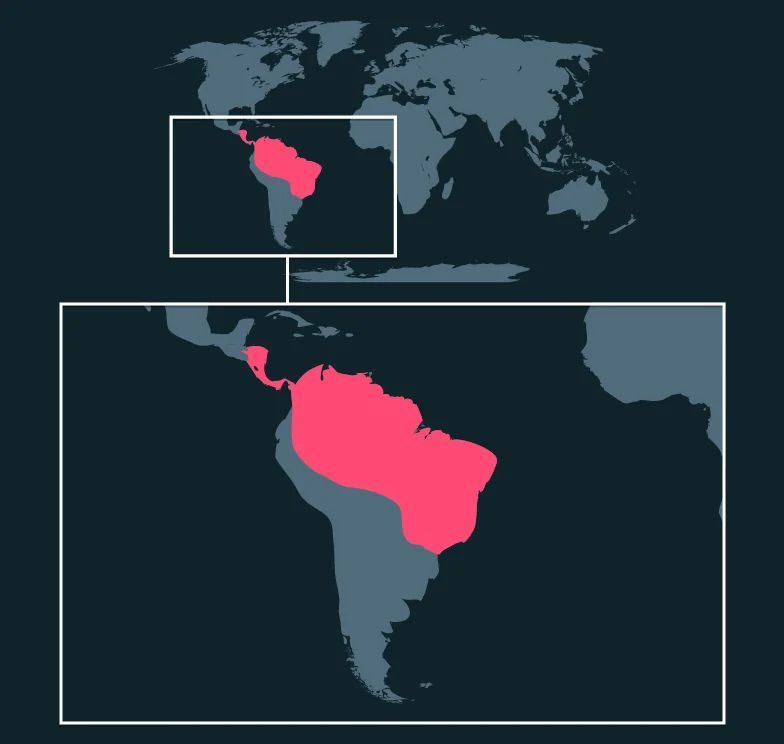
Found in South America
Regions
- South America
Biomes
- Rainforest
- Savannah
Size & weight
Size
Leg span: 0.12 m
Measured as Leg span. The person stands 1.75 m tall for scale.
Conservation
IUCN Red List
Not evaluated
Least concern
Critically endangered
Morpho butterflies, including the Menelaus blue are not currently considered endangered. They are pressured by habitat destruction and unsustainable collection. Many morpho species rely on old, low canopy woodland, much of which has been removed by deforestation. Additionally, the large size, bright colouration, and slow-moving nature of these butterflies mean they have been sought after by collectors and are relatively easy to catch. Conservation initiatives and indigenous communities are promoting ecotourism relating to morpho butterflies in order to educate about the species. This does occur in protected ecosystems across its range. The outlook for this species is unclear without additional research and monitoring. In particular, the taxonomy of morpho butterflies is poorly understood, with many competing examples among collectors and breeders.
Social & reproduction
Keeper notes
The Menelaus blue morpho is solitary, only spending time with others to mate. However, they tolerate nearby conspecifics, and on rare occasions are known to swarm to exploit a resource such as a sun spot or a food source. Mating season is year-round, with peaks around rainy seasons. Male Menelaus blue morphos establish territories containing food sources attractive to other butterflies. The more vibrant the blue of their wings, the stronger the signal to rival males and potential mates. When a male wants to mate, he releases pheromones to attract female Menelaus blues. Females select a mate based on his pheromone signal, the brightness of his wings, and the quality of his territory. An interested female will land next to the male and allow him to mate. Copulation occurs facing away from each other while joining the tips of their abdomens. Shortly after mating she lays 50 to 100 eggs one at a time, one egg per leaf. After 12 days, the caterpillars hatch and feed on plants for a period of 14 to 30 days. In this time they go through 5 instars – developmental phases – before forming into a chrysalis. They pupate for 2 to 8 weeks depending on environmental conditions and then emerge as adult Menelaus blue morphos. Adults begin feeding immediately when hatched, and attempt mating soon after. The Menelaus blue morpho only lives for 3 to 4 weeks in its adult form and will die soon after mating and laying eggs.
Animal facts
- The Menelaus blue morpho mainly feeds on fermented fruit. It has been suggested that this food source intoxicates the butterfly, causing it to fly slowly and clumsily.
- The Menelaus blue morpho is named after the mythological King of Sparta, Menelaus.
- The Menelaus blue morpho caterpillar does not spin a cocoon like other species of butterfly, but instead grows the cocoon shell under its skin.
- The wings of the Menelaus blue morpho butterfly are highly iridescent and have been researched by scientists to see how it can be replicated technologically.
- The Menelaus blue morpho can fly in the rain due to the hydrophobic nature of its wings.
Taxonomy
Class
Order
Family
Genus
Species