Overview
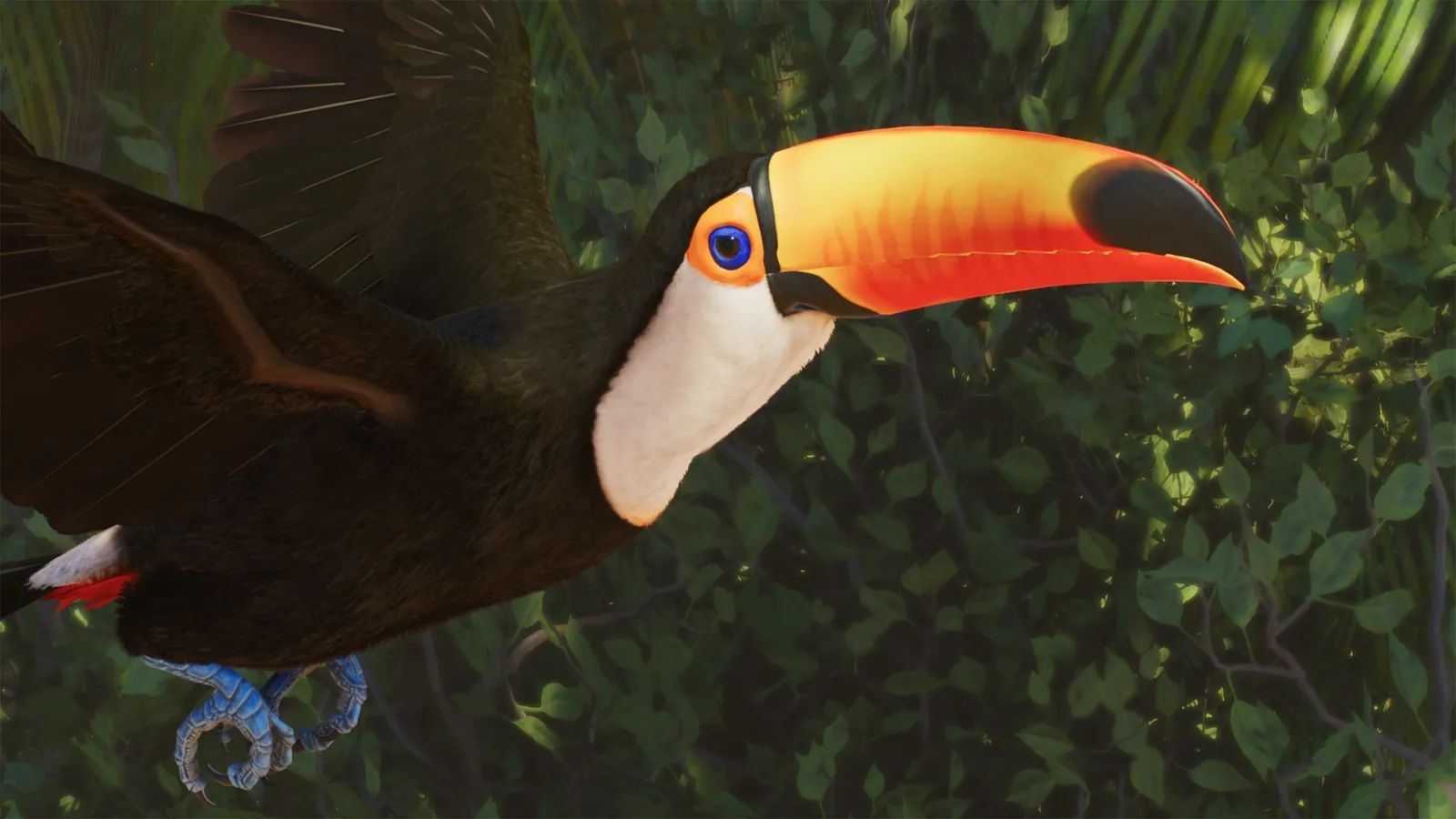
The toco toucan (or Ramphastos toco) is a bird native to central and eastern South America, with a wide range extending from the Guianas and northern Brazil south through Bolivia, Paraguay, northern Argentina and Uruguay. These toucans inhabit a variety of semi‑open habitats including woodlands, savannas, forest edges, plantations, and Cerrado. Toco toucans have predominantly black plumage with a white throat and chest, bright orange‑yellow beaks with a black tip, and a distinctive blue‑ringed eye surrounded by orange skin. Their bill is very large. Adults typically measure about 55cm to 65cm in length and weigh 500g to 876g, with males usually slightly larger than females.
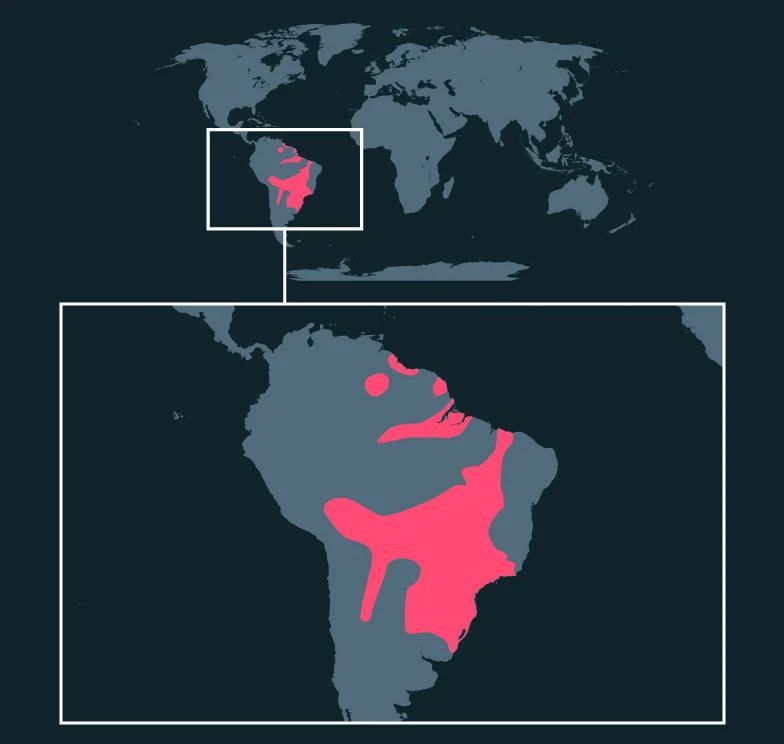
Found in South America
Regions
- South America
Biomes
- Rainforest
- Savannah
- Wetlands
Size & weight
Size
Length: 0.56 m
Measured as Length. The person stands 1.75 m tall for scale.
Habitat requirements
Barrier grade
Grade 2 of 5
Minimum height
1 m minimum
Climbing & water
Climb proof
Not needed
Water barrier
Not allowed
Combine this animal with others in the barrier planner.
Conservation
IUCN Red List
Least concern
Least concern
Critically endangered
Wild population
10,000
Estimated more than 10,000 in the wild. Rank 17 of 57 species with a known count, smallest first.
Toco toucans are considered a species of Least Concern due to their very large range and ability to exploit a variety of habitats. Toco toucans are reliant on large fruiting trees and natural tree cavities for nesting and feeding. Populations are believed to be declining because of habitat loss and fragmentation as forests are cleared for agriculture, logging, cattle ranching and infrastructure development. Toco toucans are sought after as exotic pets for their colourful bills and charismatic appearance, reducing local numbers and disrupting social structures when juveniles are taken from nests. Protected areas safeguard key forests and ecological resources where toco toucans live. Reforestation initiatives reconnect fragmented landscapes for access to food and nesting sites. Laws regulate international trade and curb the capture and transport of wild individuals. In some regions, rehabilitation and reintroduction programs directly support population recovery for the long-term stability and resilience for this iconic species.
Zoopedia sketchbook
Social & reproduction
Keeper notes
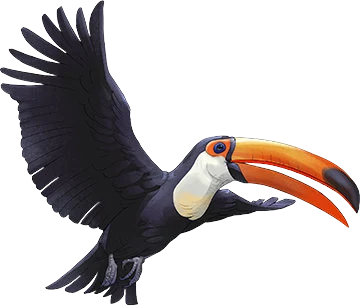
In the wild, toco toucans are most often seen alone, in pairs, or in small family groups, especially during the breeding season when pairs form strong bonds. Outside the breeding season, they may gather in loose flocks of up to 6 to 10 individuals, particularly at feeding sites or communal roosts. Breeding varies by location, but typically occurs from August to February, peaking in the rainy months of September–December. Toco toucans engage in a seasonal and cooperative reproductive cycle that revolves around strong pair bonds and shared parental care. They are monogamous, often forming long-lasting partnerships that endure through a breeding season (and sometimes across years) and engaging in courtship behaviours such as mutual preening, bill-touching, vocalisations, and playful fruit tossing between the male and female. After pairing, the birds select a nesting site in a tree cavity or other natural hollow (sometimes reusing abandoned woodpecker holes or termite mounds), where the female lays a clutch of 2 to 4 eggs. Both parents take turns incubating the eggs for about 15 to 20 days, with the male often providing food to the incubating female and engaging in shared nest defence. Once the chicks hatch, both adults feed the young by regurgitating food and the chicks grow rapidly, developing feathers and their characteristic large bills over time. Fledging typically occurs 6 to 8 weeks after hatching, after which juveniles remain dependent on parental guidance for some time as they refine their foraging and flight skills. Toco toucans reach sexual maturity at 3 to 4 years of age, at which point they can begin to form their own pairs and repeat the annual reproductive cycle.
Animal facts
- Toco toucans are the largest species of toucan.
- The bill of the toco toucan can be up to 20cm long, approximately a third of its body length.
- Toco toucans are important seed dispersers and often help regenerate tropical forests.
- Toco toucans nest in tree cavities.
- Toco toucans are intelligent problem solvers and can be trained to do tricks.
Taxonomy
Class
Order
Family
Genus
Species