
Witch Hand
Profile
Category
- Anchored Life
- Subcategory
- Tunics
- Entries in Tunics
- 6
- Words
- 198
PDA entry
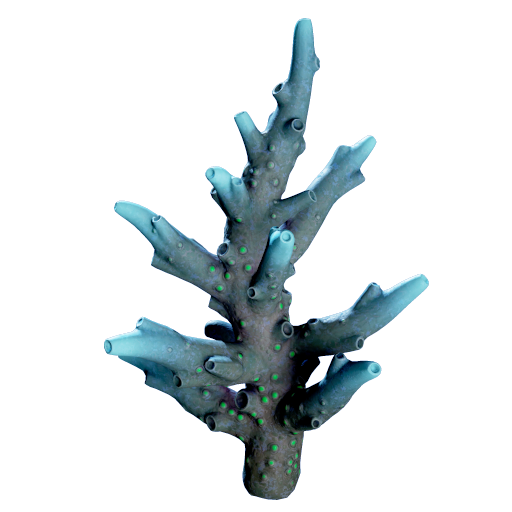
- Arthrotunic goetiachira, the witch hand. A colonial tunicate with a tough, flexible outer shell that has adapted to constant twisting and breakage by an outside force.
- 1. Tunicate origin
- Like the titan rockbore, the witch hand is a colonial tunicate, built from many tiny zooids which cooperate to build a shared structure. The exterior tunic is a polyproteovinyl plastic, similar to that found in some raions and shootroots, but some areas of the hand are left exposed for feeding.
- 2. Filter feeder
- A heart at the base of each limb draws water into the witch hand's feeding pores.
- 3. Tormented structure
- The knobby joints in the witch hand's structure are designed to flex under sudden gripping or tearing pressure. There is a tightly coupled relationship between the failure point of each joint and the strength of the witch hand's holdfast to the seafloor. Upper limbs can be torn away and lost as a sacrifice, but in other cases (such as lower joints) the witch hand prefers to be plucked whole. Once detached from the seafloor, the witch hand's twisted, thorny body plan may help it avoid being swallowed.
- Assessment: a sign of large, grasping predators in the ecosystem.
Related entries
Rotsac cherimoya.
Salp pendulous.
Hecaton tunic.
Tentatively Rotsac lucifer, the light-bringing rotsac.
Tunic aeolian.
Loading discussion...