
Hecaton Tunic
Profile
Category
- Anchored Life
- Subcategory
- Tunics
- Entries in Tunics
- 6
- Words
- 192
PDA entry
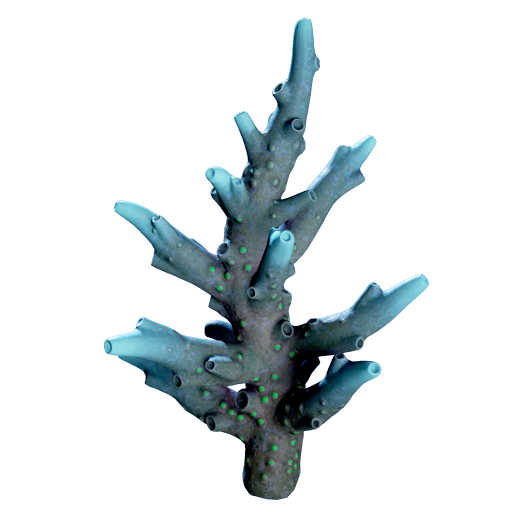
- Hecaton tunic. Named for the hundred-handed hecatoncheires of Greek myth. A complex of animals undergoing competitive sex differentiation.
- 1. Anatomy
- Each pore on the surface of the hecaton is the mouth of a tunic, a complex filter-feeding animal. The colony's branching structure allows each tunicate acces to the water so it can breathe and eat. Each tunic grows a flexible, semi-hard polyvinyl shell which merges with the neighbors' tunics, defending the entire colony.
- 2. Growth patterns
- Analysis suggests the colony begins as a single stem of identical tunicates cloned from an embryo. More successful tunicates become large and sexually mature, starting new arms of the colony and developing their own eggs. Less successful tunicates are driven to the ends of the arms, where they shrink and develop a teal bioluminescence.
- 3. Viral reproduction
- The less successful tunicates do not release sperm. Instead, they are heavily infected by a strain of large RNA virus in the seawater. The majority of the tunic's genome consists of copies of this virus insert by retroviral action. How the hecaton tunic fertilizes eggs is therefore unclear - it seems to lack sperm cells.
- Assessment: reproductive enigma. Await further updates.
Related entries
Rotsac cherimoya.
Salp pendulous.
Tentatively Rotsac lucifer, the light-bringing rotsac.
Tunic aeolian.
Arthrotunic goetiachira, the witch hand.




Loading discussion...