
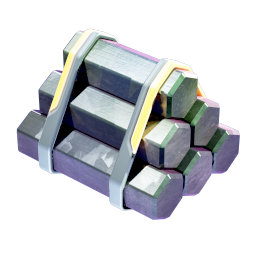
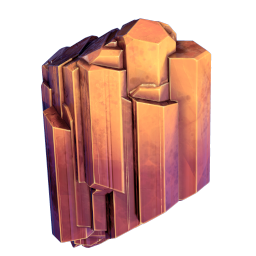
Axum Ingot
Profile
Category
- World
- Subcategory
- Resources
- Entries in Resources
- 23
- Words
- 185
PDA entry

- A bewildering blend of ocean metals and microbial products.
- 1. High-entropy alloy
- Contains more than a dozen elements, including manganese, nickel, cobalt, strontium, iron and sulfur. These atoms form a microlattice inhabited by bacterial colonies, which protect and heal the alloy.
- 2. Ocean metal
- Axum alloy evolved from two conditions: the presence of rich polymetal nodules littered across the seafloor, and the absence of high-temperature fire or forging. Over thousands of years, the Axum learned to separate and combine these metals using only cold electrical and bacterial processes.
- 3. Cultural process
- The development of these alloys may have been closer to viniculture than to scientific metallurgy. Expert Axum might use sound, smell, touch, taste and electrical sense to monitor alloy formation, introducing different combinations of bacteria, metal feedstock and electrical current to modify the results.
- 4. Laterally inferior
- Although the bulk properties of Axum alloy are apparently inferior to transgov metals, there are peculiar and unexpected exceptions. The alloy reveals the history and divergent technology of an alien species.
- Assessment: requires complex processing of multiple mineral inputs. Important to construction or reconstruction of Axum technology.
On the wiki

Related entries
Atacamite (Cu2Cl(OH)3).
A live culture of Protean microbes (Monobiota), single-celled scyllidae algae, and large sea viruses of the...
Celestine (strontium sulfate, SrSO4).
Kagome optical fibers derived from shock quartz.
Copper (Cu), element 29.
An egg cluster laid by the deepwing brooder, Titanotagmatapterya amalthea.
Germanium (Ge), element 32.
Gold (Au), element 79.
Lead (Pb, element 82).
Lithium (Li), element 3.
Debris from a human habitat or vehicle.
Hardened industrial runoff.


Loading discussion...