Jelly Ring
Profile
Category
- Mobile Life
- Subcategory
- Foragers
- Entries in Foragers
- 17
- Words
- 299
PDA entry
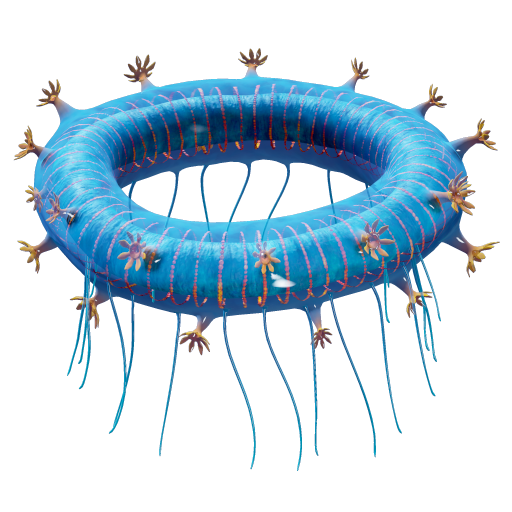
- Jelly ring (tentatively Thermodont sufganiyah, heat eating jelly donut). Not a jelly, but full of jelly. Feeds on the heat and chemical flux of hydrothermal vents.
- 1. Pyrosome
- A colony of tiny clone animals called zooids. Unlike solitary tunicates (like the lucifer rotsac), these zooid tunicates work together to build a larger structure.
- 2. Ring
- The jelly ring settles around hydrothermal vents like a wheel on an axle. When a vent dies, the jelly can migrate to a new vent by swimming.
- 3. Mucus baskets
- Flowerlike structures around the ring are mucus-lined pumps for water and hydrothermal vent flux. The pumps can be reversed to serve as swimming thrusters. They also serve as exchange sites for organisms feeding on the ring's interior jelly.
- 4. Inner jelly
- The inner toroid circulates hot, mineral-rich water pulled in by the mucus baskets. Specialized zooids digest feedwater (using symbiotic bacteria) into a latex-like sap. This jelly coagulates on contact with water, plugging holes in the ring. It is rich with complex chemistry, including sugars, starches, oils and gums.
- 5. Bioluminescence
- The zooids in the jelly ring communicate with light, rather than nerve cells. The ring is strongly bioluminescent and will react to stimuli.
- 6. Jellyfall
- Earthly jellies and pyrosomes die and fall to the sea floor, fertilizing the deeps with nutrients. Strangely, there are signs that living jelly rings travel to deep sites and expel their jelly - giving up their calories for no apparent benefit. Natural selection cannot produce behaviors which hurt the individual to help the ecosystem. (Alterra ecology experts consider theories of multi-level selection obfuscatory and counterproductive.) This may be a farming behavior, or a donation to unknown relatives on the seafloor.
- Assessment: may be a source of complex chemistry and even edible fats or sugars if tapped. Likely flammable in air.
On the wiki

Related entries
A morph of Monopter astrapakantha which scavenges the charge crystals of dead hoverthorns.
An enormous crab (tentatively Ostrakonskelos anaktoraphore, hard-legged palace-bearer) that hides among...
Postpanoplia epicurean, the voracious unarmored armored fish.
Seaslug kleptopharos, the stolen beacon slug.
Geordie (tentatively Salpapod geordie).
Halfmoon (tentatively Moliform luna).
Hammerhead (tentatively Panoplia hammerhead).
Subspecies of the halfmoon, Moliform semiluna, with no apparent behavioral or biological distinction.
Monopter astrapakantha, the one-finned lightning thorn.
A simple animal, closely related to corals, characterized by a symmetrical body and trailing arms.
Jetocaris (tentatively Tripod phrontiscaris).
Ostrakonskelos periskopion, the hard-legged periscope.