Epicurean
Profile
Category
- Mobile Life
- Subcategory
- Foragers
- Entries in Foragers
- 17
- Words
- 203
PDA entry
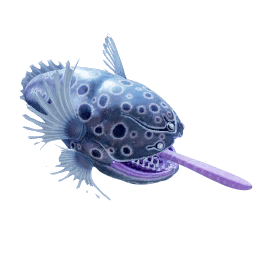
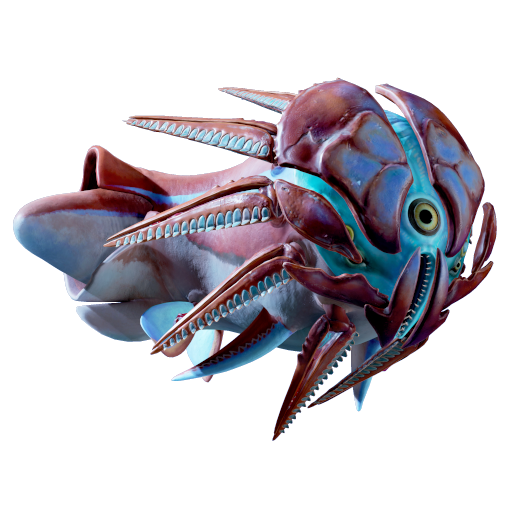
- Postpanoplia epicurean, the voracious unarmored armored fish. Unpredictable and hungry, especially when under the influence of a parasite.
- 1. Sea hippo
- The epicurean is a true omnivore, consuming dozens of kilograms of animals, microorganisms, minerals and corals every day. Digesting this diet is expensive, fueling the epicurean's hunger. By devouring and defecating, the epicurean spreads nutrients and fine-ground sand, making it a keystone species in its ecosystem.
- 2. Lobe-finned enormity
- The epicurean is a younger relative of the hammerhead, but it has lost its armored shield, allowing it to open its huge grinding jaw. Both the central pineal eye and the lateral eyes are fully developed. These changes suggest the epicurean no longer competes in tournaments for territory and mates.
- 3. Hunger
- The hungrier the epicurean, the more likely it is to attack a pioneer.
- 4. Parasite
- The epicurean often swallows parasites with its food, which take root in its mouth, blocking nerve pathways which signal fullness to the epicurean's brain. Infested epicureans believe they are starving, and attack with ravenous hunger. Explore methods to expel the parasite, and try to avoid becoming an unsatisfying meal.
- Assessment: ecologically vital but an unpredictable danger to divers. Check for and (if possible) expel mouth parasites.
On the wiki

Related entries
A morph of Monopter astrapakantha which scavenges the charge crystals of dead hoverthorns.
An enormous crab (tentatively Ostrakonskelos anaktoraphore, hard-legged palace-bearer) that hides among...
Seaslug kleptopharos, the stolen beacon slug.
Geordie (tentatively Salpapod geordie).
Halfmoon (tentatively Moliform luna).
Hammerhead (tentatively Panoplia hammerhead).
Subspecies of the halfmoon, Moliform semiluna, with no apparent behavioral or biological distinction.
Monopter astrapakantha, the one-finned lightning thorn.
A simple animal, closely related to corals, characterized by a symmetrical body and trailing arms.
Jelly ring (tentatively Thermodont sufganiyah, heat eating jelly donut).
Jetocaris (tentatively Tripod phrontiscaris).
Ostrakonskelos periskopion, the hard-legged periscope.