
Gateway Spire
Profile
Category
- Anchored Life
- Subcategory
- Anomalies
- Entries in Anomalies
- 4
- Words
- 249
PDA entry
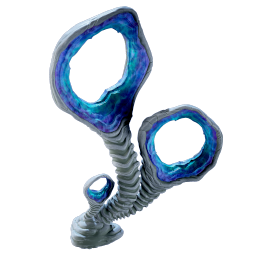
- Although technically alive, gateway spires are constructs more akin to termite mounds.
- 1. Impeller ring
- The oldest part of each gateway spire is the impeller ring. This ring contains a loop of conductive, metallic bacterial fibers surrounded by layers of polymer similar to polyaniline. When exposed to electrical current, the bacterial wires create Lorentz force, pushing water through the ring (and pushing the ring in the opposite direction).
- 2. Tracheal petiole
- The stalk (or petiole) supporting the impeller ring resembles a human trachea. Each disc is a colony of soft coral polyps joined by a tough, flexible tissue (the coenenchyme). The hard outer surface is a layer of living diatoms - silica shells covered in tacky mucus.
- 3. Constructor species
- Gateway spires are assembled by a species of social krill, Krill krikophore or the ringbearer krill. Though too small to see unaided, these krill build the entire gateway spire: first laying hoops of bacterial wire, then secreting polymer insulator and gathering polyps of coral and samples of diatom to build the support stalk. The behavior of the ringbearer krill resembles Earth's carpenter wasp.
- 4. Ecological niche
- The gateway spire is a biological tollbooth, drawing in water rich with plankton, krill, and other marine meiofauna. The ringbearer krill feed on these prey and nutrients. Related colonies of ringbearer krill will attempt to align their gateway spires into continuous highways.
- 5. Power source?
- The gateway spire's source of electrical current is not immediately apparent.
- Assessment: Possibly useful as a mobility aid.
Related entries
Databank generation alert: known scientific theory inadequate to explain specimen.
Databank generation HALT.
Discoidea ilusium, a cellular slime mold named for the celebrity D. discoideum amoeba.
Anchored Life › Algae
Anchored Life › Algae
Anchored Life › Algae
Anchored Life › Bloom
Anchored Life › Bloom


Loading discussion...