
Bloom Biofilm
Profile
Category
- Anchored Life
- Subcategory
- Bloom
- Entries in Bloom
- 5
- Words
- 173
PDA entry
- Biofilm is an external structure created by bacteria - a city to support their growth. The first bodies on Earth were probably biofilms.
- Biofilms allow bacteria to colonize hostile substrates, like medical equipment or exposed rock face.
- 1. Unusual toughness
- A crystalline protein structure similar to spider silk - too tough to cut by hand. May be vulnerable to sonic resonance.
- 2. Internal electrical network
- Nanowires allow bacteria to share electrons for different metabolic reactions. Capable of growth even in extreme environments.
- 3. Multiple bacterial species
- Optogenetic analysis detects thousands of distinct strains in the film. Reproductive patterns anomalous.
- 4. Viral superinfection
- The film is infected with two strains of large RNA virus (generated name "Proteavirus alpha" and "Proteavirus beta"). These strains are in competition: viruses from one strain infect and destroy bacteria infected by the other. Possibly a case of interguild predation?
- 5. Possible kharaatypic activity
- Some structures within the biofilm distantly resemble kharaa microforms encountered in the Ariadne Arm. Further analysis required.
- Assessment: Ecological unknown. Possibly dangerous. Avoid contact or find a tool to destroy.
Related entries
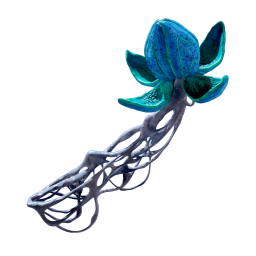
This chimeric organism (Viroblast gaggraina) is a feeding and reproduction site for a large RNA virus...
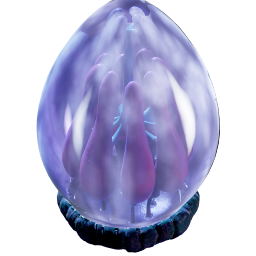
This animal (Cecidia gamikos) has no Earthly analog.
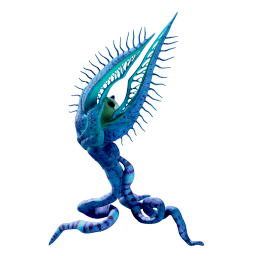
This animal (tentatively Cecidia ctenophora) is a symbiote with - or parasite upon - the titan rockbore below.
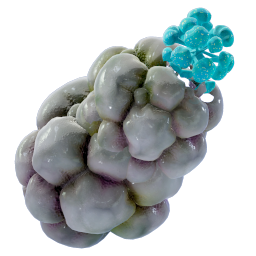
A water slug (Seaslug hydroclast) infected by an aggressive bacterial bloom and trapped in its own secretions.
Loading discussion...