
Fleur-de-lance
Profile
Category
- Anchored Life
- Subcategory
- Molluscs
- Entries in Molluscs
- 4
- Words
- 285
PDA entry
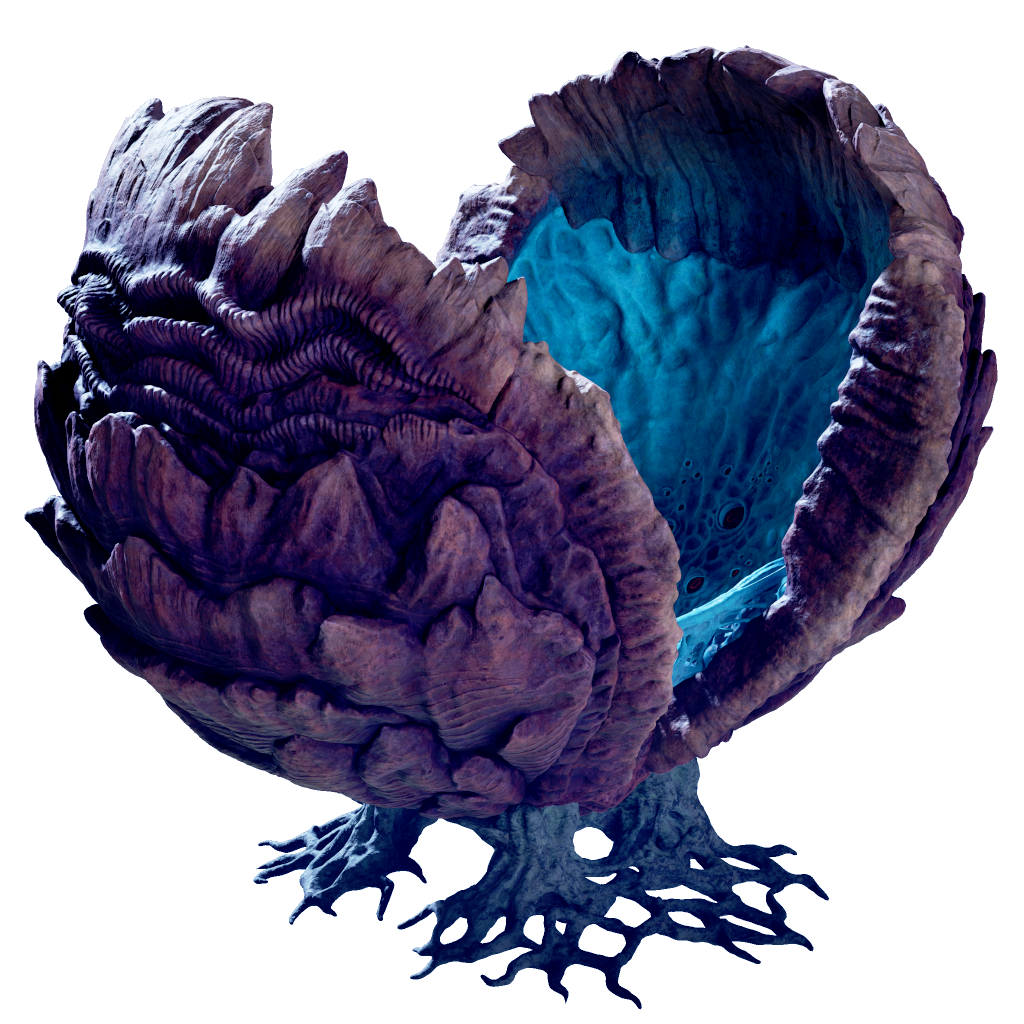
- Anaiktothuriondae lancea, the lance flower. A swollen mollusc unable to close its shell. Apparently locked in a vicious process of runaway selection.
- 1. Fisherian runaway
- Fisherian runaway, also known as the 'sexy son hypothesis', suggests that female organisms tend to select male mates which will produce the most attractive (and thus evolutionarily successful) sons. A particularly attractive trait may be so strongly selected for that it comes to dominate the entire organism. A classic (though controversial) example is the plumage of the peacock.
- 2. Swollen mollusc
- The fleur-de-lance is a stack of cloned bivalve clams, like the stagged mephit. The lower clams are female. The uppermost is a male. The females cannot close their shells because their sisters grow within them. The male cannot close its shell because it is too sexy.
- 3. Sexy son
- The male fleur-de-lance receives the bulk of the colony's calories, which it uses to grow a tumescent body and a large reproductive organ that emits spores. This display attracts the free-swimming male spores of other fleurs-de-lance, which fertilize the females' eggs. This competition is winner-take-all. The most attractive fleur-de-lance in an area produces nearly all the offspring.
- 4. Reproductive arsenal
- The fleur-de-lance's spores are tiny, flagella-propelled organisms. Some carry extra nutrients as a nuptial gift to fertilized females. Others are soldiers which gather around an attractive male fight off or subvert the spores of rival males. Spores may form alliances to control access to a particularly fit male.
- 6. Ecology
- The fleur-de-lance's spores provide vital nutrients to its ecosystem, but it is unclear that the fleur-de-lance feeds well enough to sustain its lifestyle in the long term. The open shell and swollen flesh are attractive to predators.
- Assessment: somewhat foppish.
Related entries
Great jaw (tentatively Megamya sudacna, great clam that bites you).
Limaster pedigree, the pedigree of slugs.
Mephit ceryneian.
Anchored Life › Algae
Anchored Life › Algae
Anchored Life › Algae
Anchored Life › Anomalies
Anchored Life › Anomalies

Loading discussion...