
Blister Oolapu
Profile
Category
- Anchored Life
- Subcategory
- Unknown
- Entries in Unknown
- 3
- Words
- 212
PDA entry
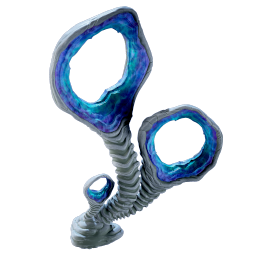
- Oolapu blister, index species of a newly discovered clade resembling Earth's crinoids (sea lilies and feather stars). Challenging to categorize.
- 1. What is this?
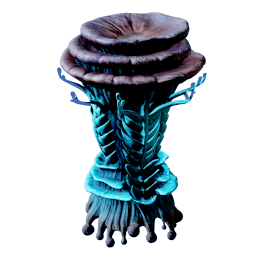
- At first scan, baffling. The central beak suggests an anchored cephalopod, like the mimic pylon. The bell structure resembles a stalked jelly such as the necrolei, and the fringe growths are kelp-like. The anchoring holdfast resembles the cradle shootroot's.
- 2. Life cycle
- The blister oolapu begins life as a five-limbed larva. These limbs stitch together into a closed sac, and the juvenile oolapu feeds by contracting this sac to pump water. As it matures, the blister oolapu develops a sharp beak, and its limbs separate again.
- 3. Possible symbiotic partner
- The adult blister oolapu may depend on other organisms to drop hard, indigestible food into its gullet. It uses its jaw to grind this refuse into nutrients, excreting the remainder as fertilizer into the water. This feeding strategy is roughly the inverse of the cabbage shootroot's.
- 4. Social organism
- The blister oolapu expresses a circular nerve cord, and its chemical signals appear to respond to individual organisms it 'knows'.
- Assessment: probably a recycler or detritovore feeding on remains too tough for other organisms to eat. It is growing more difficult to find consistent Earth analogs for Protean life.
Related entries
Protozooblast soros, a true slime mold of basal animal cells.
Discoidea pneumakatechon.
Anchored Life › Algae
Anchored Life › Algae
Anchored Life › Algae
Anchored Life › Anomalies
Anchored Life › Anomalies
Anchored Life › Anomalies

Loading discussion...