Skip to content
WikilyWIKILY
All games17 Wikis · pick your game
Periscopic Clowncrab
● Small · Herbivore · Coral Gardens

Periscopic Clowncrab

Ostrakonskelos periskopion, the hard-legged periscope.
The Periscopic Clowncrab is a small herbivore found in Coral Gardens. It has 50 fixed spawn points.
  • 5Health
  • 50Spawn points
  • SmallSize
  • HerbivoreDiet

Profile

Reference
Spawn depth
12 to 32 m
Sight range
7 m
All creatures
Map

Spawn locations

Every fixed spawn point
Open the full map

Behaviour

Who it attacks and flees from
Flees from
other creatures within 7 m

Databank

Periscopic Clowncrab
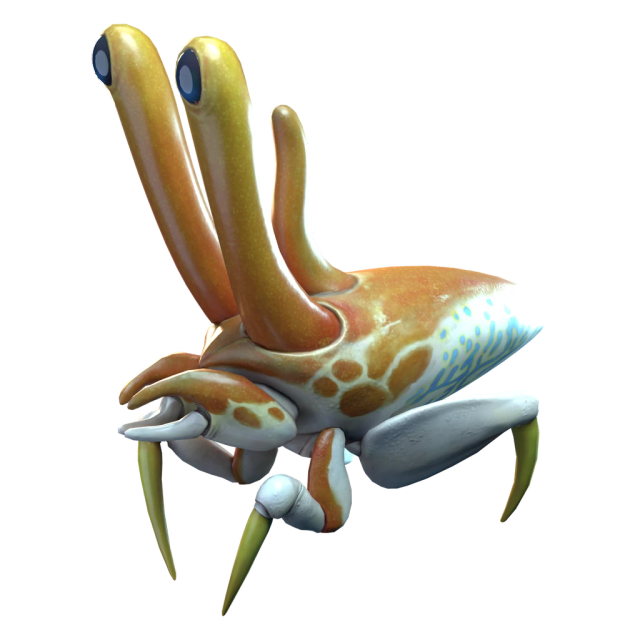
Ostrakonskelos periskopion, the hard-legged periscope. A social crab that shelters among stinging anemones. 1. Reduced body The clowncrab's single-segment body is an illusion. The multiple segments of other Protean arthropods are still present, nested inside. When the clowncrab molts, it sheds its internal shells through its digestive tract. 2. Regenerative eyestalk Enormous eyestalks mimic the surrounding raions. If bitten off by a predator, each stalk is packed with unspecialized cells that quickly regenerate missing eyes. If the stalks grow too long, the clowncrab will trim them to avoid drawing attention. 3. Raion tender The clowncrab provides a valuable service to sessile raions by ranging out to forage, returning nutrients in its molt and waste. It also grooms the raions to clean parasites and infections. 4. Fecund stalk The third stalk behind the eyes is a reproductive organ. The same unspecialized cells used to heal the eyestalks become eggs or sperm. Sperm is released into the seawater, while eggs are deposited among raions. Assessment: sign of a healthy raion field. Caught script hook in allocated memory for command >> generate-databank "Clowncrab" >> echo \memory-carve -signature=0xSEABEEF5 >> restore-remarks Remark A. Centipede! I think the PDA got this thing's anatomy and reproduction completely wrong. I swear I've seen centipedes - a bunch of clowncrabs linked up in a train. I think they grow as a single, segmented organism and then each segment splits off into its own crab. And then maybe they hook up again later? It wouldn't be the weirdest thing we've seen.
Loading discussion...