
Oblast Coral
Profile
Category
- Anchored Life
- Subcategory
- Corals
- Entries in Corals
- 11
- Words
- 285
PDA entry
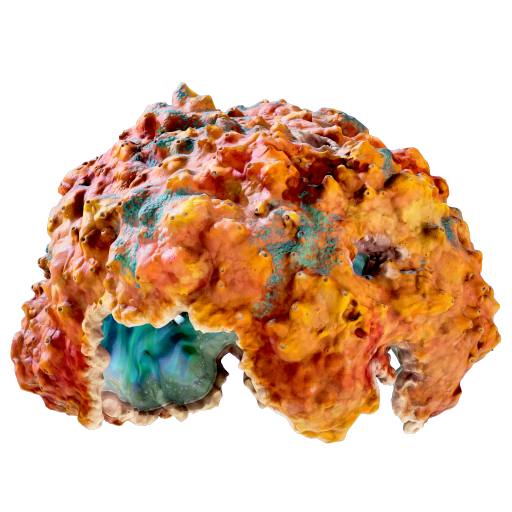
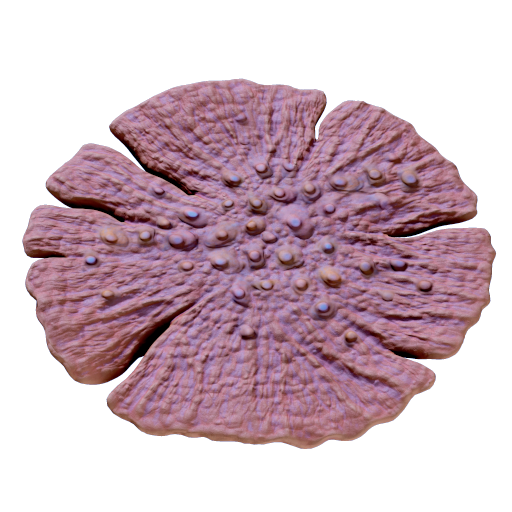
- Tentatively Coral oblast. A chimeric mass of coral, sponge, and raion species that produces a reservoir of spores. Named for the level of administration above a raion.
- 1. Morphology
- The oblast grows from the outside in. Patches of specialized coral polyp, raion worms, and sponge pumps form first, then cooperate to channel food to a bed of sponge bud tissue. Spectrogenetic analysis detects markers associated with starvation and stress.
- 2. Enigmatic development
- Does the oblast begin as a patchwork of adults from different species, or a single stem cell with the genome of all its members?
- 3. Spore stash
- The heart of the oblast is a mass of billions of sponge spores called gemmules. Each gemmule contains the genome of all the oblast's member species, preserved to last millions of years - but lacks the cellular machinery required to grow. Why does the oblast spend its energy creating nonviable spores?
- 4. Viral absence
- Genetic recombination and duplication is associated with Proteavirus infection. Yet the spore cells contain no live retrovirus.
- 5. False cooperation
- It is tempting to imagine the oblast as a seed vault, created by each member species to transfer their genes into a more viable future. (One might imagine the spores as escape pods which genes use to abandon their doomed bodies.) But this cooperation is impossible under modern evolutionary theory. Each species in the oblast would be better off using its energy to make copies of itself, not shared spores. Bioenergetic analysis by Karakoç, Shoemaker and Lennon confirms that long-term sporulation is an expensive last resort that complex organisms discard in favor of short-term advantage.
- Assessment: Confounding. The oblast is a cooperative project for future survival, but competition in the present determines evolutionary success.
Related entries
Databank autogeneration interrupted.
"In the early stages of the Holocene Collapse, the bleaching of coral became a metaphor for the breakdown of...
Gorgon thalamiskos.
Coral geodesica.
Gorgon aulaia.
Coral dragonscale.
Gorgon Kryphakous or Listening Gorgon.
A hard coral that frequently grows on hydrothermal vents.
"There's nothing unnatural in nature.
Gorgon mastix, the whip gorgon.

Loading discussion...