Skip to content
WikilyWIKILY
All games17 Wikis · pick your game
Waxmoon
● Large · Carnivore · Coral Gardens

Waxmoon

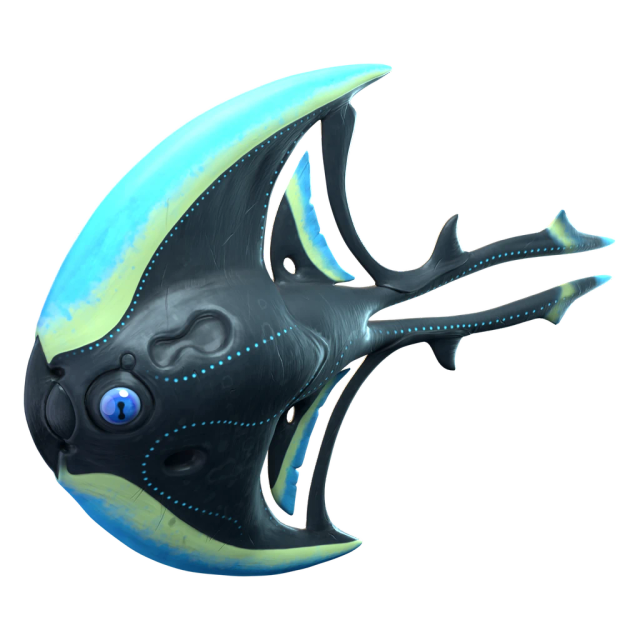
A large halfmoon (Moliform semiluna) with developed fin structures and sophisticated senses.
The Waxmoon is a large carnivore found in Coral Gardens and Karakorum. It has 15 fixed spawn points.
  • 1,000Health
  • 15Spawn points
  • LargeSize
  • CarnivoreDiet

Profile

Reference
Found in
Karakorum
Spawn depth
7 to 317 m
Sight range
9 m
Scan time
4 s
All creatures
Map

Spawn locations

Every fixed spawn point
Open the full map

Databank

Waxmoon
A large halfmoon (Moliform semiluna) with developed fin structures and sophisticated senses. 1. Developmental threshold Quorum-sensing vitelline organs in the halfmoon's gonads detect a critical population of other halfmoons*, triggering a burst of growth in the halfmoon's genes, fin structure, and nervous system. 2. Gene structure Much of the growth is polyploid - an abnormal process where cells do not divide, but instead duplicate their genes internally. These cells build a fortified matrix of polylactic bone wax, defending the waxmoon against trauma and parasites. 3. Fin structure The main body and the caudal filament knit together behind the anterior fins, creating a 'fin guard'. This grafting of separate body parts is rarely observed in animals. In Earthly trees it is called 'inosculation'. 4. Nervous system The halfmoon's already-dense nervous system develops explosively. Large clusters of neuromasts spot the skin. Synaptic connections between neurons grow like a second childhood. The system still lacks reafference cancellation: it cannot distinguish external input from its own internal processes. 5. Final form? The waxmoon retains its vitelline organs, indicating it may undergo future growth spikes into yet-unobserved forms. Assessment: puzzling. Hypothesis: the waxmoon is a schoolmaster and controller node for schools of halfmoons. It takes in information from its schoolmates and trains its larger nervous system to sense hidden cues in the environment, using the entire school as a sensor net. *Caveat: while vitelline membranes generally bind to reproductive cells of the same species, the halfmoon's organs do not. Instead they react to the reproductive cells of any species. This output process has failed to generate a plausible explanation.
Loading discussion...